Topic
“Ceramic 3D printing combines craftsmanship with digital skills,” says designer Jan Vítek
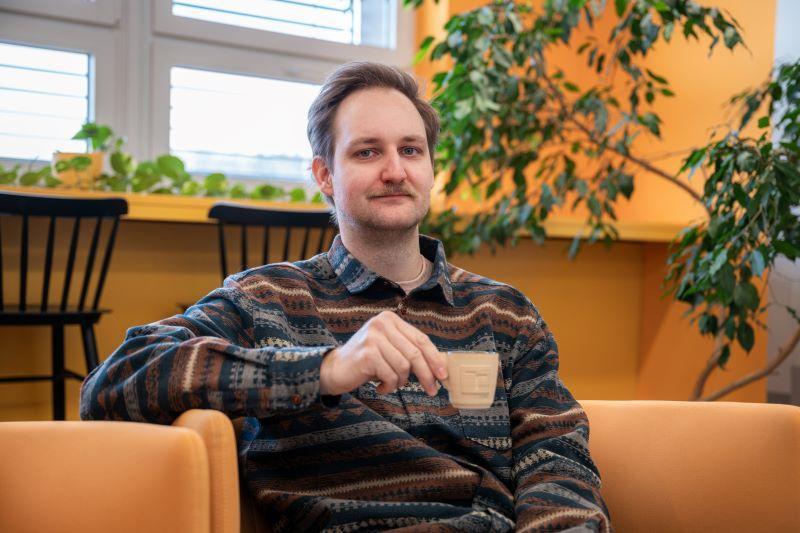
What first drew you to ceramic 3D printing?
I first encountered it while working on my bachelor’s thesis. I was particularly interested in parametric and generative design methods, and an opportunity arose to explore porcelain 3D printing in collaboration with a porcelain studio in Brno. At that point, I was actually more interested in the design methods than in porcelain itself.
I explored SLA printing and also tried developing my own material containing porcelain. The result was a small series of porcelain cups. The subject fascinated me so much that it has stayed with me ever since. Later, I returned to it in depth for my doctoral thesis at the Faculty of Fine Arts BUT.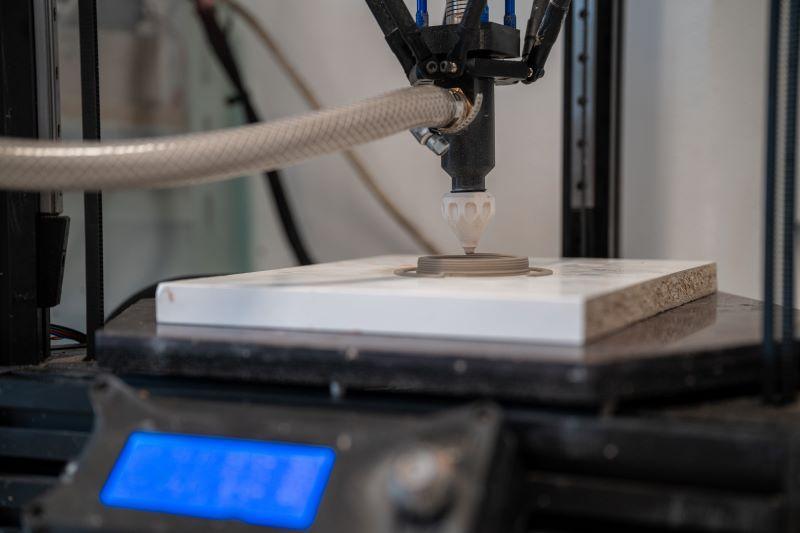
So it did not start with pottery classes?
I did attend pottery classes, and I really enjoyed them. I also used ceramics for my hobby, growing bonsai – I needed to make my own pots. So I came to the subject from several directions, but the collaboration with the porcelain studio was crucial. It was very enriching and motivated me to keep going.
How would you describe the principle behind ceramic 3D printing?
Surprisingly, it is similar to one of the oldest pottery techniques – building a vessel from coils of clay. A potter rolls out a coil and gradually builds up the shape. The printer essentially does the same thing: it extrudes material through a nozzle and deposits it in layers along predefined toolpaths.
Some authors abroad therefore use the term Computer Assisted Coil Building. In a way, modern technology builds on a traditional pottery technique.
Do you need a special clay mixture for printing?
You can use ordinary pottery clay. However, you need to adjust its consistency with water so that it passes smoothly through the extruder and nozzle. Both smooth clay and clay containing grog can be used. Grog can help reduce deformation and allow the print to hold its shape better, but its particles must not be too large, as they could wear down the extruder. Ultimately, it is still pottery clay.
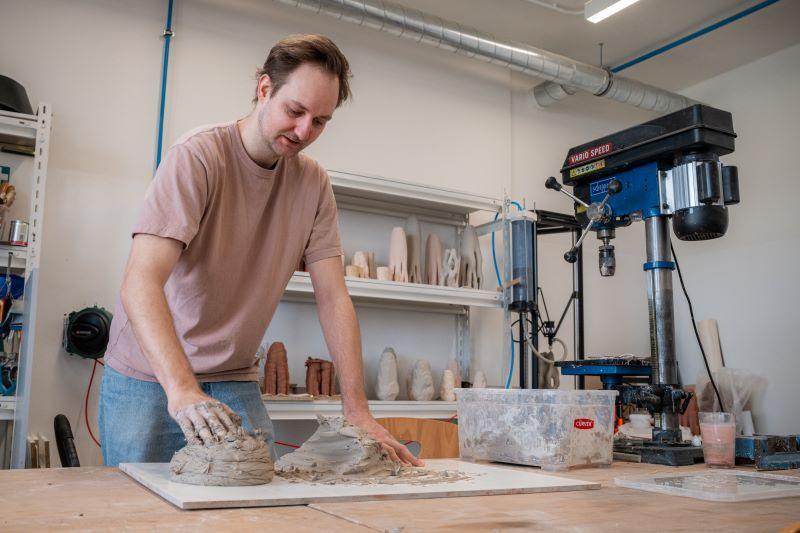
Where do you see the main advantage of additive manufacturing over conventional ceramic production techniques?
Primarily in one-off pieces and small production runs. Conventional production often uses plaster moulds, which are relatively expensive to make. They therefore only become economically viable when producing larger quantities.
With 3D printing, I can change the digital design almost instantly. If I want to create another version of a product, I change the input data and print it. In conventional production, I would often need a new mould for every substantial change. This opens up much greater scope for variation and customisation in design.
You also built your own printer during your PhD. How challenging was that?
Commercial solutions for ceramic 3D printing exist, but they are relatively expensive. I had a rough idea of how the equipment works: a reservoir feeds material into a screw extruder, which pushes it through a nozzle.
So I decided to try building my own. A long period of development and gradual fine-tuning followed. It took about two years for the printer to work the way I had envisaged. I think its results are now comparable to those of some commercial machines.
Digital technology that still needs craftsmanship
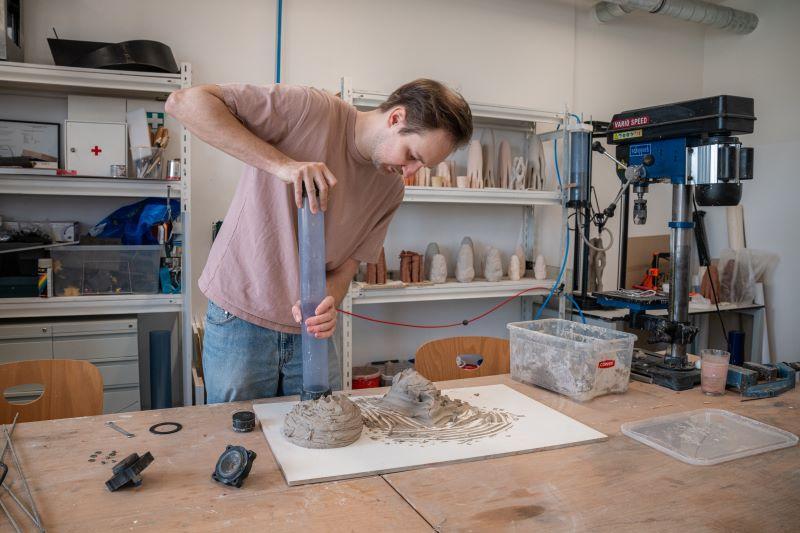
What is the hardest part of ceramic 3D printing?
The fundamental difference from printing plastic is how the material behaves. Plastic solidifies relatively quickly after being deposited. Clay hardens by drying, which is much slower, so the entire piece remains soft throughout printing.
It can therefore collapse or deform, and features such as overhangs are harder to create. Sometimes you need to help the print dry as you go, using warm air, for example. But clay also has one advantage: it is not hot. If I need to support an overhang briefly with my finger or prop it up with a piece of clay, I can. Once it has dried, these interventions can be touched up relatively easily.
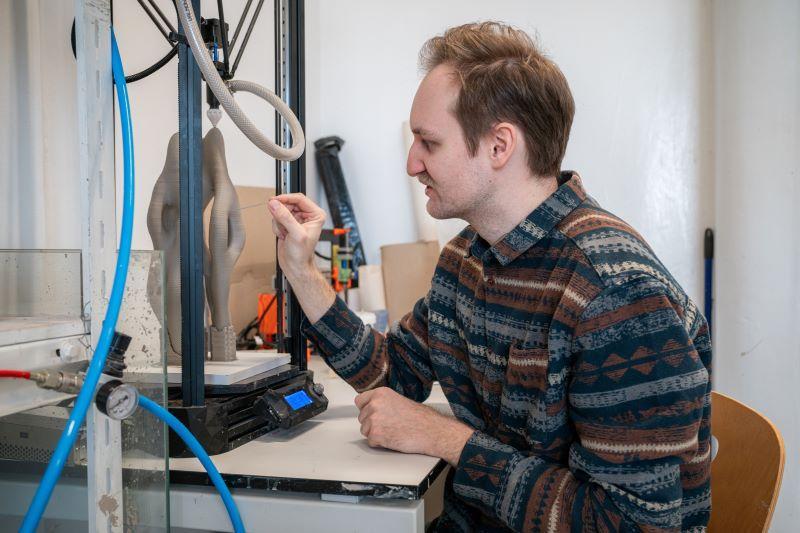
Does that mean ceramic 3D printing is less automated than people might imagine when they hear the term digital manufacturing?
Exactly. We often associate 3D printing with the idea that you send data to a machine and then leave it to get on with the job. With clay, it is still very much a craft. You have to know the material, understand how it behaves, monitor the printing process and intervene when necessary. It is precisely this combination of traditional craftsmanship and digital skills.
What surprised you most about the possibilities of ceramic 3D printing?
Above all, how much clay can withstand. I was surprised by how thin the walls can be and how much detail you can achieve. Initially, I also thought the softness of the material would severely limit the complexity of the shapes.
But it turned out that if you find the right approach, you can create objects that would be virtually impossible to produce using conventional methods. The technology therefore opens the door to entirely new forms.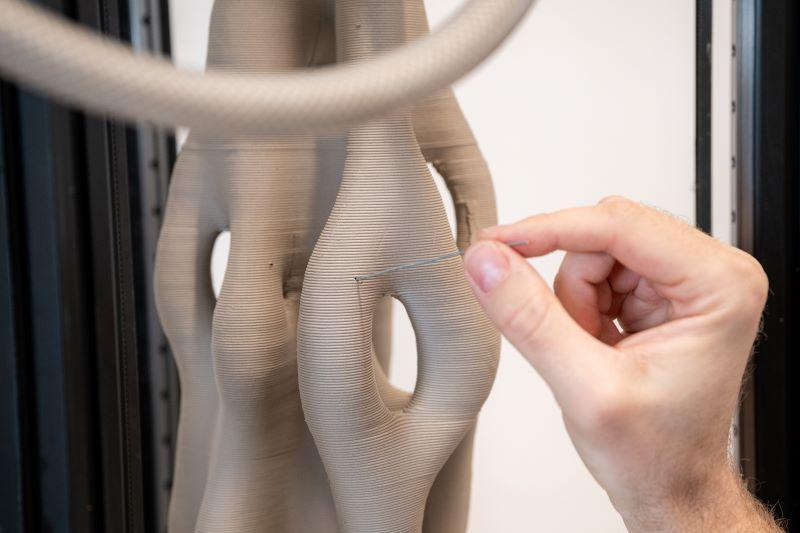
Why would some shapes be impossible to make using conventional techniques?
Moulds, for example, can be a problem. You have to be able to remove the product from them. If an object has awkwardly oriented undercuts, internal recesses or very complex geometry, you need an extremely complicated mould – and sometimes there is no way to divide it into sections that would allow the product to be removed. Naturally, the more complicated the mould, the more expensive it is. In many cases, 3D printing eliminates this problem.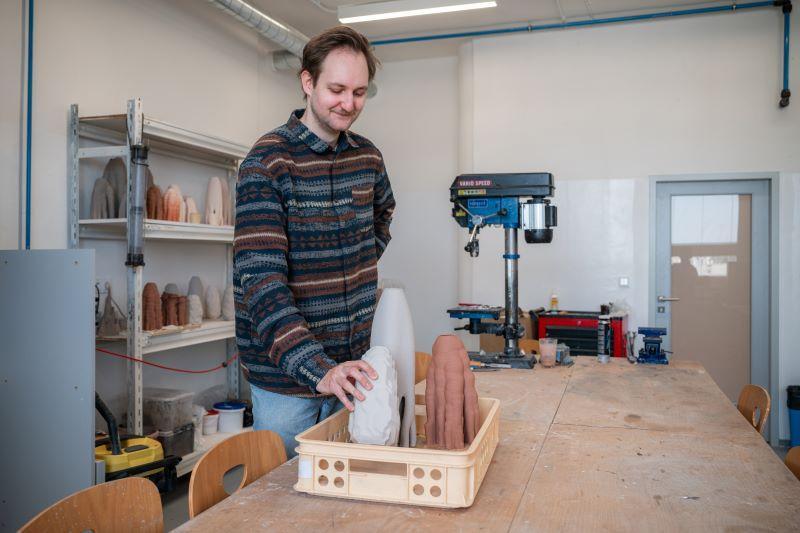
Ceramic 3D printing need not be limited to design objects. Where else do you see it being used?
A lot depends on the specific technology. Powder-based ceramic printing, for example, is also used for precision engineering and high-temperature applications. The extrusion printing I work with is less precise because of the layer height and the width of the extruded material, so it is not suitable for certain highly specialised technical applications.
But I see great potential in large-format printing and architecture. Clay is an interesting material in this respect, partly because it can be sourced locally. In the past, clay for construction was also sourced locally, much like the material used by local brickworks. Today, experiments are being carried out with small-scale structures and additives that can improve clay’s resistance to moisture. Compared with concrete, clay has interesting properties in terms of both sustainability and the indoor climate of buildings. Of course, many problems still need to be addressed: drying large prints, cracking, structural failures and water resistance. But I believe further development can overcome some of these obstacles.
You also presented your printer and ceramic 3D printing at the international FabX gathering. How did visitors respond?
I was delighted by the unexpectedly high level of interest. The workshop was originally planned for ten people, but more than thirty turned up. Afterwards, people from different parts of the world, even New Zealand, wrote to me asking for details and sharing the results of their own experiments. I also discussed the subject with colleagues from the University of Porto.
I think people are drawn both to the fact that ceramic 3D printing is still a relatively new and unexplored field and to the material itself. Ceramics have a completely different character from plastic. That combination of a beautiful traditional material with digital technology is what appeals to me, too.
Thank you for the interview. To conclude, I would like to add that anyone interested now has another opportunity to attend the workshop, this time at Maker Faire Brno. The festival will take place at the Brno Exhibition Centre over the weekend of 17–18 October. Jan Vítek’s workshop will be held on Saturday morning. Tickets can be purchased online on the Maker Faire website.
The ceramic 3D printing workshop was developed as part of the DiSTT project, funded by the Interreg Central Europe programme.
Source: BUT FME


For cleaner and "greener sky"
I enjoy applying mechanical engineering to the human body, says doctoral student
A special tribometer customised by Brno scientists for a Japanese company
Smart dispatching system for virtual power plants co-developed by experts from FME BUT
For water of even higher quality. Cavitation and low-temperature plasma technology purifies water from pesticides and hormones