Sport
Football can be played as well as analysed. Eliška Jordánková from BUT can do both

Eliška Jordánková's life has been shaped by two worlds since childhood – technology and football. Her dad introduced her to the first one. "My dad is an IT expert, and together with my older brother, computers were part of our home. From computer games I naturally became interested in how they are made, which led me to my first experience with algorithmics and the basics of programming languages." She fell for football in primary school, when she started playing with her classmates. "Originally I did athletics, but I always enjoyed team sports more. I like that they are more long-term and that you can influence the result right up to the end."
At BUT she found a place for both sport and technology
She managed to bring the two worlds together at university, when she came across the Sports Technologies programme at BUT's Centre of Sports Activities at the last minute. "I found the programme maybe two days before the application deadline. Throughout my studies everyone kept asking me what it was I actually did; a lot of people have no idea what to even imagine under the term sports technologies." She doesn't regret her decision. "I liked that the subjects weren't purely technical. We also had sports subjects, where we had the chance to try out various disciplines," she approves.
Eliška is currently continuing in the master's programme Bioengineering at the Faculty of Electrical Engineering and Communication, which is the most natural choice for anyone interested in further education in this field. "There are a some strictly medical topics that don't interest me all that much, but at the same time there is a lot I can use in sports analytics," Eliška comments.
During her bachelor's studies she already began specializing in data analysis and machine learning. "I enjoy working with data because of the opportunity to look at problems from different perspectives." Her specific focus was cemented during a part-time job at the IT company Aricoma, where she got involved in a project addressing the role of sleep quality in the performance of hockey players. "We wanted to use the Whoop smart band, which uses sensors to measure various values, such as heart rate, heart rate variability or the length of different sleep phases."
Eliška also explored the topic in her bachelor's thesis, even though she never got to see the results because the club ended the project early. "I'd like to carry on with it, but in hockey specifically the funding just isn't there to make it possible."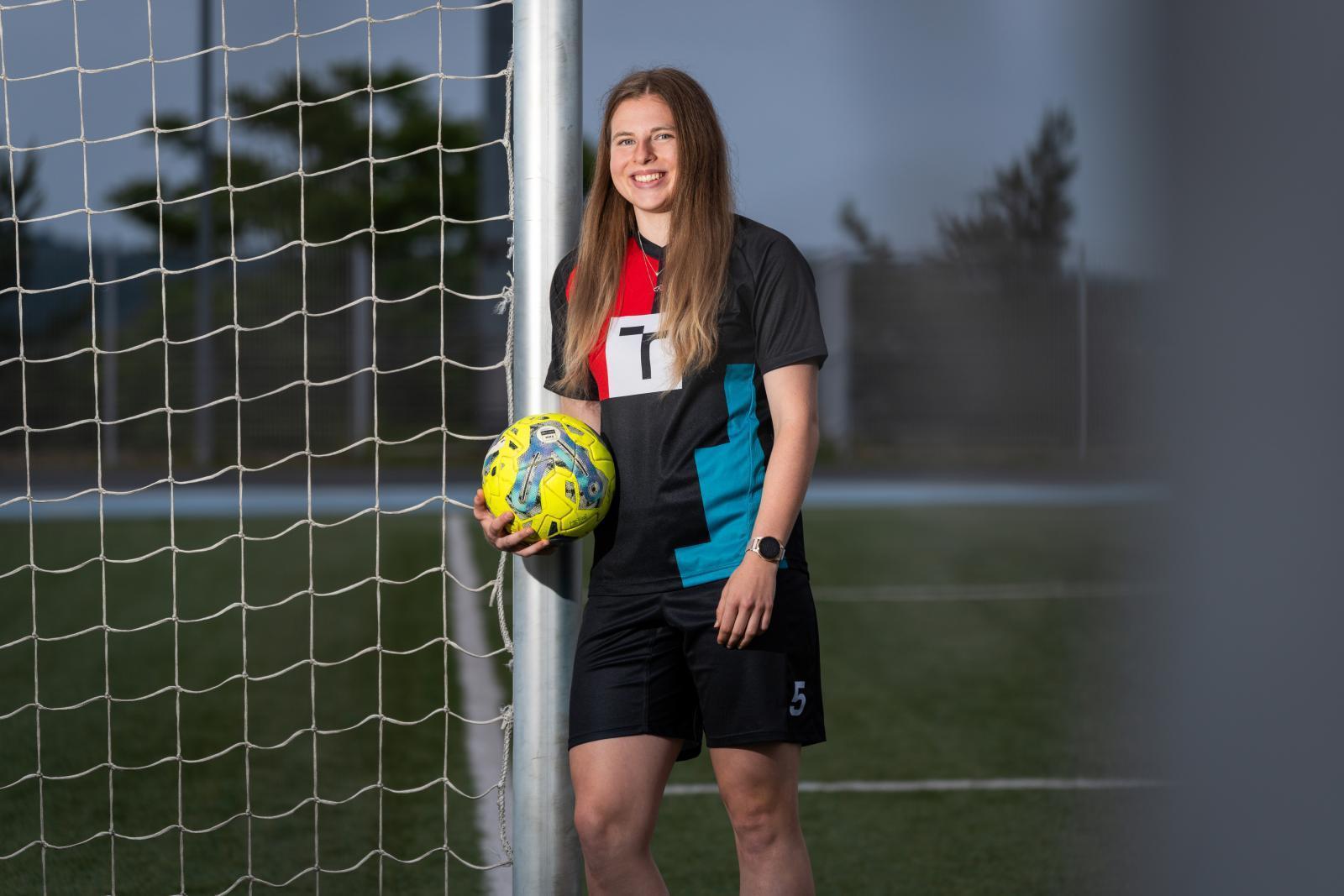
Football as a lab for sports technologists
Football is an ideal terrain for sports analysts. "In adult football, matches last a fair while, and there is a lot you can track during them," Eliška explains. Data is collected using a whole range of technologies, from camera systems and sensors in the ball through wearable devices (so-called 'wearables') to accelerometers on the boots. And the manufacturers aren't far from BUT; for instance, the Brno-based company Panoris, founded by BUT graduate Igor Potůček, focuses on tactical video systems for use in football.
But the enormous amount of data collected has to be interpreted, and according to Eliška it is precisely analysis and machine learning that can find details a person might overlook. "Analysis can, for example, point to factors that flag possible injuries in advance. These are various asymmetries, where a footballer overloads one leg, for instance. From a tactical point of view, there are then different metrics such as expected goals or possession and loss of the ball."
Numbers aren't enough. Players need context
The key isn't just to collect the data, but also to be able to translate it for the footballers. "Players can get a report with a pile of numbers and metrics that aren't relevant to them," Eliška points out. "From their point of view I completely understand that they don't feel like digging through it and working out what it actually means."
Sports technologists can help to bridge that gap. "With players, you need to include the context as well. On top of that, each of them needs different data, and based on the context an analyst can pick out the metrics that matter to them and that they can work on. A defender needs to look at different data than, say, a forward."
That being said, data isn't all-powerful. It is equally important to take players' subjective feelings into account. Eliška experienced this firsthand on the hockey project. "It was one of the things we were dealing with – whether the measuring itself might affect them psychologically in some way. A player might subjectively feel that they slept well, but the data says the exact opposite. You have to explain to them that the data can help them, but they shouldn't become fixated on it."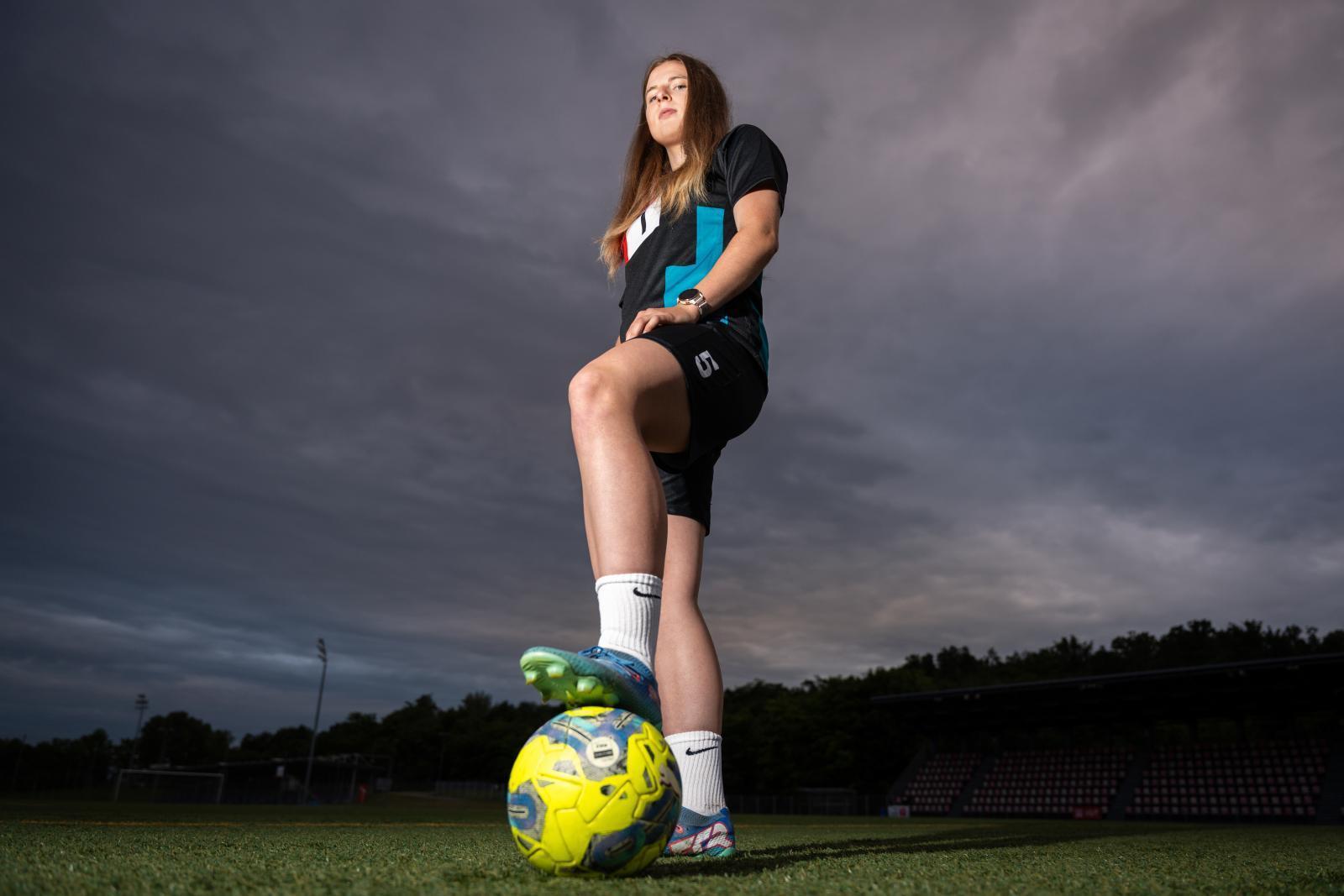
A left-back who understands data
Eliška has been playing football for fourteen years. From the small school pitch where she played with classmates, she made her way into club competitions, passing through TJ Čechie Zastávka, FC Zbrojovka Brno, 1. FC Slovácko and Brno's Lokomotiva. Today she plays as a left-back for the women's team SK Artis Brno.
"Ever since I was little I've always tended to defend, maybe partially because I wasn't very good at scoring goals," Eliška laughs, adding that in modern football the role of defenders has become more complex. "From my position I support the attack a lot, and during play we often swap with the midfielder. I like that I have more tasks and that there is a lot of running involved."
She regards her experience on the pitch as a career advantage. "If I wanted to join a Czech club in the future, it's definitely an advantage for me that I can add sporting context to the data for a player. At the same time, it's important that I can put myself in their situation as a player and that I understand it can throw them off in some way."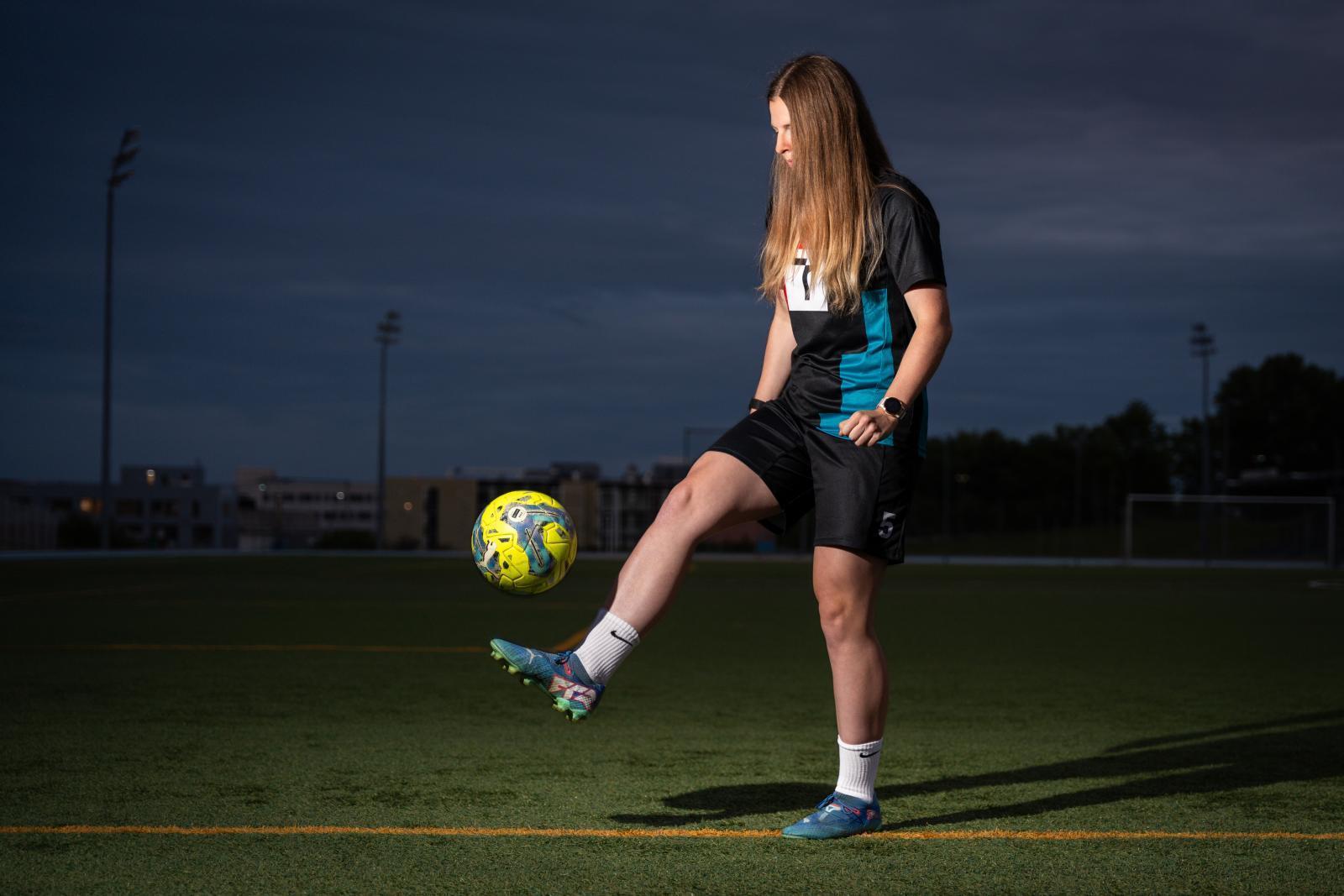
Combining football with her studies isn't easy. "It's demanding, because even though we're in the second league, our matches take place all over the country and, paradoxically, we play in more distant locations than we would in the first league – for example in Teplice or Liberec. On top of that there are training sessions three times a week. But it can be managed." Eliška also represents BUT in the newly formed women's futsal team, which is making its debut at this year's Czech Academic Games.
Different football, same commitment
The fact that both the world of technology and football are male-dominated doesn't seem to phase Eliška. "I know that a lot of female footballers struggle the typical opinions that girls shouldn't play. But I have to say I've never had a problem with that. On the contrary, I've always gotten admiration rather than prejudice from people. The same goes for IT. People are more surprised by it, but again in a good way."
She thinks attitudes towards women's football are shifting as well, even though there are still people who claim it's terrible. "It's simply different, you basically have to see it as a different sport," Eliška stresses, adding that because of women's different physiology the game is, for example, slower than the men's version.
On the other hand, she points out that women are often held to a higher standard. "When a female player in a professional league makes some senseless mistake, it gets a lot, a lot of attention." Psychology also plays a bigger role with women. "I think girls aren't quite able to separate playing from what's going on at home and so on. It throws them off more. On the other hand, they excel at teamwork."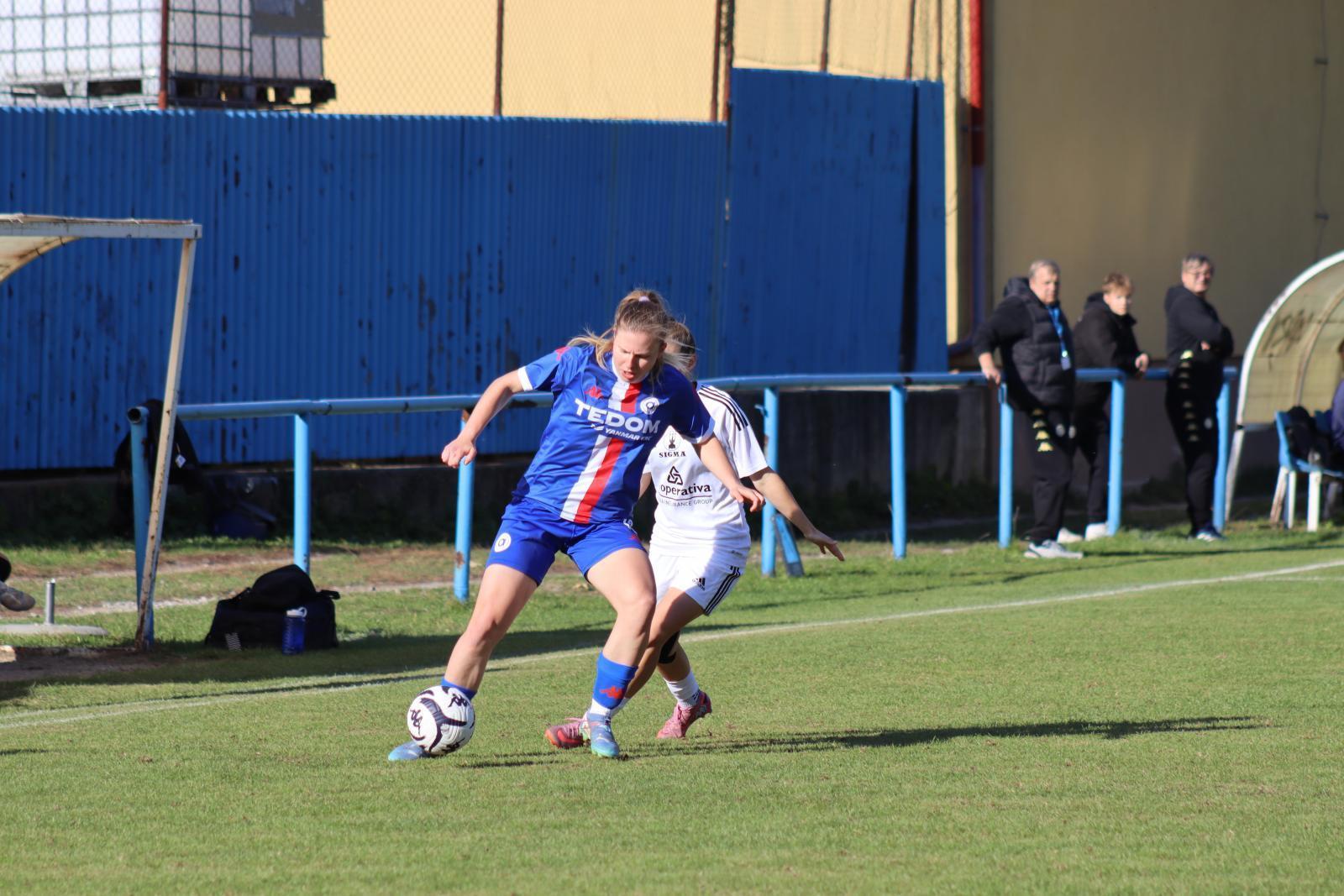
The pitch, data or a doctorate. The order is yet to be decided
In the future Eliška would like to keep working with football, technology or a combination of the two. She's taking her final Master's exam next year and will be submitting her diploma thesis project whose topic is yet to be decided. And what would she like to research if there were no limits at all? "Tough question, but probably something focused on the mind. Some kind of implementation of cognitive fatigue monitoring – for example a wearable that could be used routinely during exertion. I'm not aware of anything like that existing. And then possibly to track what effect that cognitive fatigue has on performance," Eliška adds.
She has several career options available. She'd like to continue at Aricoma and keep focusing on data and machine learning. Doctoral studies are also on the table. "I like the possibility of teaching. I used to coach children as well. It actually runs in the family, because my mum is a teacher," she explains with a smile. An analyst position with a sports team is also a possibility for her, ideally in England, where they devote themselves to the field intensively. "It doesn't have to be football specifically, even though it's the sport closest to me."
But most of all she'd like to stay in football as a player. "The ideal situation would be if I could play and focus solely on that for a while. My dream is to play abroad," Eliška reveals, adding that she'll choose her final direction based on the opportunities that come up.
Related articles:
- New boost for BUT football and futsal. Teams want to join the university league.
- Does the footballer run faster on artificial or natural grass? Sports technologists from CESA offer the answer
Author: Tereza Walsbergerová
Long season of triathlete Tomáš Kříž
Through the Špitálka smart district will be a running trail in the clouds
Women from BUT who move the world of science and technology
He was supposed to be an architect. But he studied electrical engineering and is now a recognized expert on optical systems in Canada
No space for errors. Internship in a space company forces BUT students to change their thinking