Topic
Experience BUT at Researchers' Night: What Do Human Muscles Sound Like?
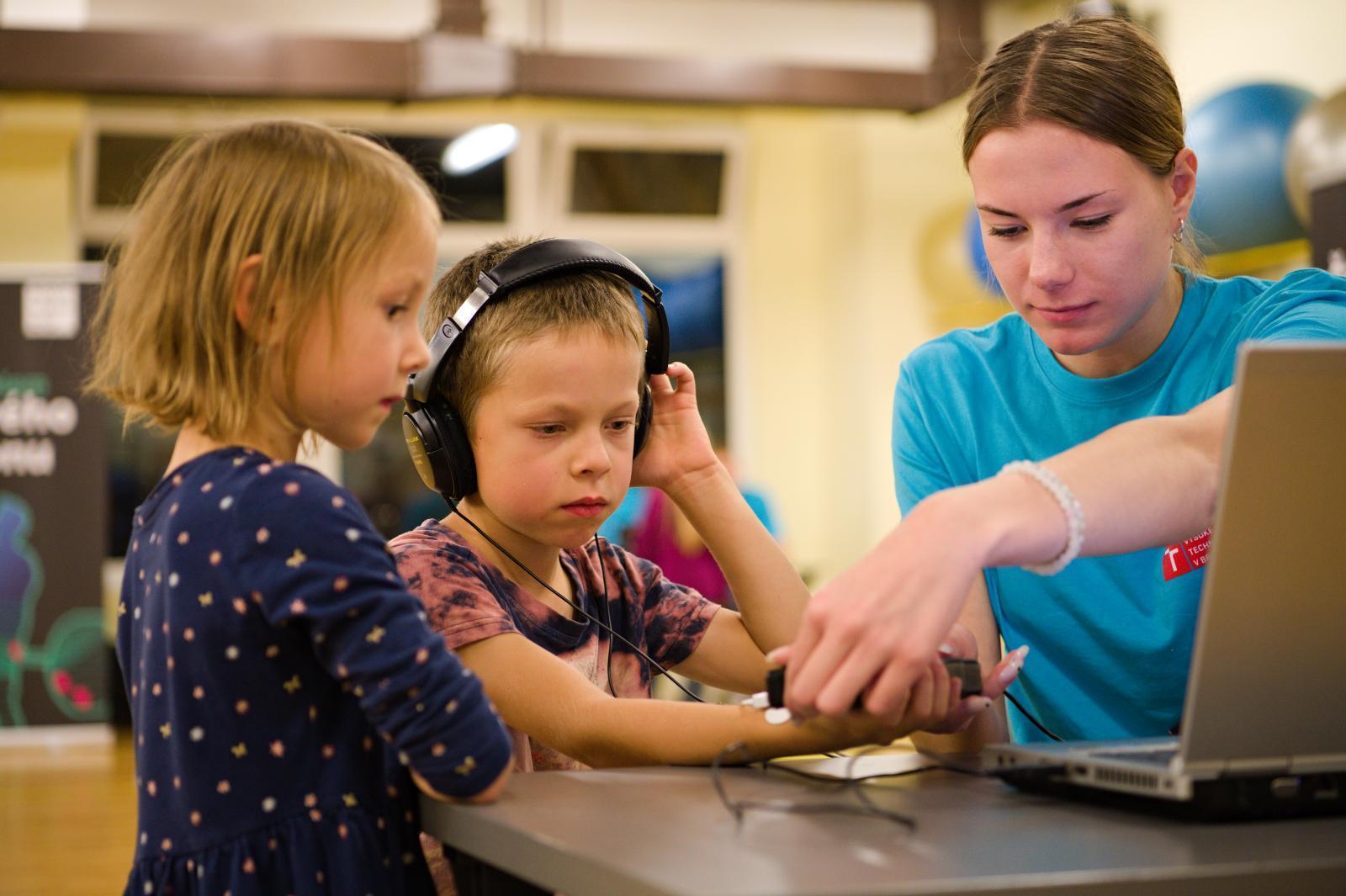
The human body is full of signals that usually go unnoticed. But what if, for a moment, we could actually listen to our own muscles? Visitors to Researchers' Night at the Centre of Sports Activities BUT will have the chance to do exactly that.
Hands-on experience! That best describes the activities and measurement methods that will allow visitors to discover fascinating insights into the way their bodies move. They can try reaction time, performance and neuromuscular coordination tests, as well as motion video analysis and even listen to their own muscles. “What fascinates me most is the opportunity to see or hear something in places where we would never expect it,” says Jan Šťastný, guarantor of the Sports Technology study programme at the Centre of Sports Activities BUT.
Muscles do much more than simply produce movement. Every contraction is accompanied by electrical activity that can be detected and analysed using electrodes and systems such as BIOPAC. A modern technique called electromyography (EMG) can even convert this electrical activity into sound that people can hear. Instead of watching complex graphs on a screen, visitors can literally listen to their muscle activity through speakers or headphones.
{{photo|DSC_6861.jpg|775}}
“I became interested in how muscle activity changes during different types of movement and how movement itself is coordinated,” explains Šťastný when describing how he became involved in electromyography. The more a muscle is activated, the stronger the recorded signal becomes. Researchers' Night visitors will discover firsthand that muscle activity is not only something they can feel – it is also something they can hear.
Turning electrical signals into sound is much more than an impressive demonstration. It has major applications in medicine and research. In rehabilitation, it serves as a form of biofeedback, allowing patients to hear how strongly they are activating their muscles instead of watching graphs on a monitor. For physicians, the audio representation of EMG can also help identify certain nerve and muscle disorders more quickly and intuitively.
And what should every young and not-so-young scientist take away from Researchers' Night? “That analysing human movement is a challenging discipline, but one that can also be explored through fun and engaging methods,” concludes the researcher.
|
Researchers' Night takes place on Friday, 25 September, with all faculties and institutes of Brno University of Technology taking part. Laboratories, classrooms and research facilities will open their doors to the public, offering a programme full of experiments, interactive demonstrations and opportunities to meet scientists. Find out more on the Researchers' Night website. Come and discover how technologies that shape everyday life are created – and experience BUT for yourself! |
Author: Lenka Hubáčková
Long season of triathlete Tomáš Kříž
Football can be played as well as analysed. Eliška Jordánková from BUT can do both
Does the footballer run faster on artificial or natural grass? Sports technologists from CESA offer the answer
Study of technology and volleyball both require perseverance and discipline. BUT gives students the opportunity to excel in both.
Experience BUT at Researchers' Night: When a Game Becomes Art