Ideas and discoveries
From Pharmacy to Microrobotics: Yanzhen Song Explores the Future of Light-Driven Medical Technologies
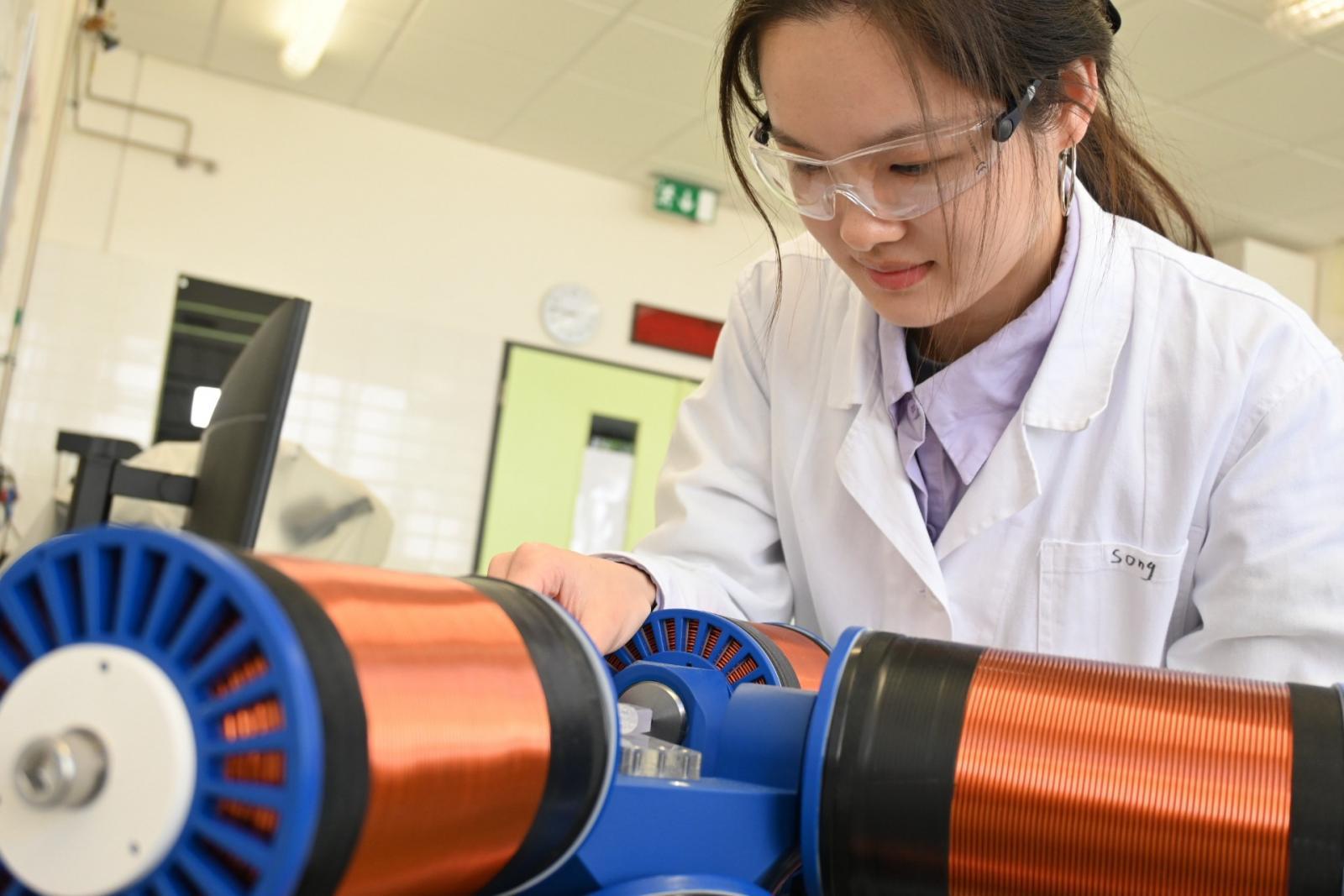
Can tiny robots one day help fight bacterial infections or deliver medicines precisely where they are needed in the human body? For PhD researcher Yanzhen Song, these questions are at the heart of her research. Working at CEITEC BUT, she studies light-driven microrobotics - microscopic semiconductor-based structures that can move, assemble and respond to light. While the technology is still in its early stages, it could one day contribute to new approaches in medicine, environmental protection and beyond.
"My current research focuses on light-driven microrobotics," Song explains. "These are based on semiconductors. After careful design, they can respond to light and perform different collective behaviours, such as self-assembling into chains or clusters. These collective behaviours are reversible."
Understanding how these microscopic robots interact is the first step. The next challenge is finding practical ways to use them.
Bringing Microrobotics Closer to Medical Applications
Song's current research project explores how microrobotics could improve antibacterial photodynamic therapy, a treatment that destroys bacteria using reactive oxygen species generated by light.
One of the main challenges is that these reactive oxygen species exist only for a very short time and can travel only limited distances before disappearing. This reduces their ability to reach and eliminate bacteria efficiently. "We are studying whether we can use the collective behaviours of microrobots to capture bacteria and bring them close to the microrobots," Song says. "In this way, we could maximise the efficiency of the reactive oxygen species."
The project has recently reached an important milestone. "We have already finished this project and are currently submitting our papers for publication," she says. "After that, we will continue working on other applications and other kinds of microrobotic systems. A PhD is never just one project."
Building on Previous Research
Although the project focuses on a different type of propulsion, Song's PhD research builds naturally on her previous experience. During her master's studies, she worked with chemically driven micromotors that rely on chemical reactions for movement. Her doctoral research instead investigates systems powered by light. "It is actually a continuation of my previous research," she explains. "During my master's studies, I focused on chemical-driven micromotors. Here, we are more focused on light-driven microrobotics. It is still the same research field, but with a different driving mechanism."
Besides studying the underlying physical mechanisms, the research team is constantly exploring new applications. "I would say everything is possible," Song says when asked about future directions. "I am currently working on medical applications, but some of my colleagues focus on environmental applications or energy-related research. It depends on what you would like to achieve."
From Pharmacy to Microrobotics
Song's academic journey may seem unusual. Before entering the world of microrobotics, she studied pharmacy, giving her a strong background in chemistry and biomedical sciences. "I studied pharmacy, so I already had some basic knowledge in this field," she says. "Usually, we read scientific papers to understand current medical problems. Based on those challenges, we can design microrobotic systems to help solve them."
Rather than leaving pharmacy behind, she sees microrobotics as an extension of it. "For example, these microrobots can move under our control. We can load them with drugs, navigate them to specific places such as blood vessels, the stomach or the intestine, and deliver the drugs directly to the targeted area. I think that is one possible future application."
She also points out that developing medical technologies requires close collaboration across disciplines. "Our research group collaborates with doctors and hospitals," Song says. "They help us with animal studies and other specialised tasks."
Fundamental Research with Long-Term Potential
Although the possibilities are exciting, Song emphasises that her group's work remains focused on fundamental research. "For our group, we are mainly doing fundamental studies," she says. "Practical applications may still take several years or even decades."
Nevertheless, she believes the field is steadily moving forward. "There are already research groups testing microrobots in the human body through clinical trials," she says. "I think eventually it will become reality."
Finding the Right Research Environment
Song joined CEITEC BUT after being encouraged by her master's supervisor, who noticed that Professor Martin Pumera was recruiting PhD students. "He suggested that I send my CV," Song recalls. "I sent an email, was invited for an interview, and eventually I was accepted."
She says CEITEC's facilities made the decision even more attractive. "I knew CEITEC had wonderful advanced facilities, so joining here was a very good choice."
Recognition Through the Brno Ph.D. Talent Programme
Alongside her research, Song also received recognition through the Brno Ph.D. Talent programme, a highly competitive scholarship for outstanding doctoral students.
Interestingly, she admits that the path to success was far from certain. "The competition has three rounds," she explains. "After the second round, my ranking was close to fortieth place, while only twenty-five students would receive the award. I was worried."
Rather than becoming discouraged, she focused on preparing for the final presentation. "I decided to do my best for the third round, and surprisingly it went really well."
For Song, the experience reinforced an important aspect of scientific research. During the evaluation, the panel focused not only on scientific quality but also on the future potential of the project. "They were interested in whether this research could eventually lead to practical applications," she says. "That is exactly what we are trying to achieve, even though it will take years. At this stage, we are mainly focused on fundamental research."
As her work continues, Song remains motivated by both the scientific questions and the long-term vision behind them. Today's microscopic light-driven robots may still belong to the laboratory, but with each discovery, they move one step closer to becoming practical tools that could one day transform medicine and many other fields.
How to apply for the new Brno PhD Talent program?
(zeh)
Motor failures in electric vehicles can be detected by mathematical algorithms from the BUT
Ordered nanocrystal ensemble that degrades pollutants using light. Meet Brno PhD Talent winner Anjali Valadi Palliyalil
Awarded student Jiří Kabát uses an electron microscope to measure the temperature of nanoparticles
Pavel Václavek: Sustainability Will Succeed If It Brings People Tangible Benefits
The memory of Josef Dadok lives on at CEITEC through cutting-edge research in spectroscopy