Topic
FEEC BUT student project shows future of colored photovoltaics

Photovoltaics is now one of the key pillars of sustainable energy. Nevertheless, many people still associate it with typical dark panels installed mainly on the roofs of houses or industrial buildings. Current developments, however, show that solar technology can take a completely different form—one that is aesthetically adaptable, colorful, and visually integrated into modern architecture.
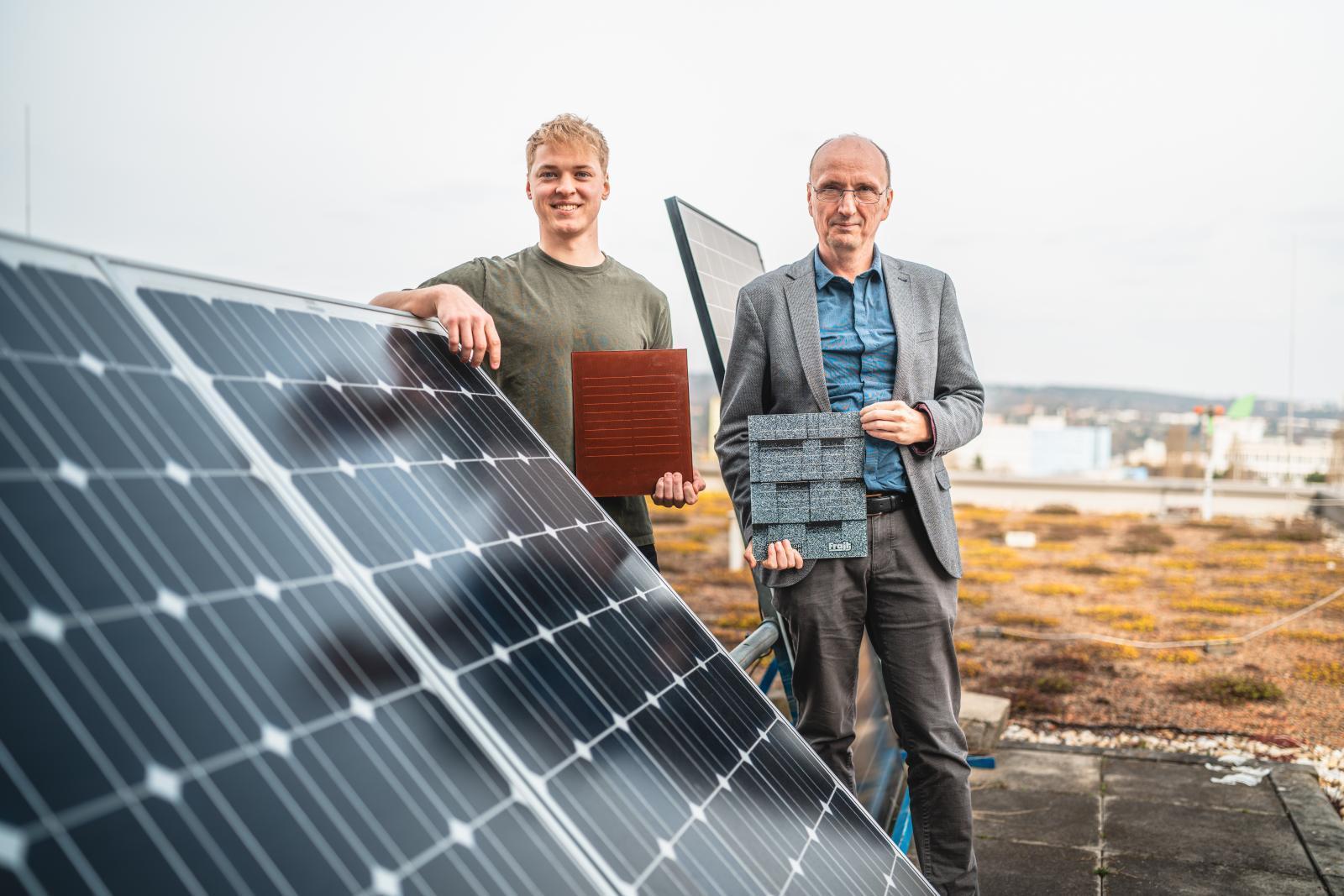
The possibilities of manufacturing colored photovoltaic modules are explored in his master’s thesis at the Faculty of Electrical Engineering and Communication of Brno University of Technology (FEEC BUT) by student Stanislav Kalousek. The work was carried out at the Department of Electrical and Electronic Technology of FEEC BUT, where under the supervision of Jiří Vaněk he focuses on technologies enabling the application of colors and patterns to photovoltaic modules, while also evaluating their impact on performance.
“I wanted to focus on an area that connects renewable energy sources with real-world applications in environments where people care not only about functionality but also about appearance. Photovoltaics must be visually acceptable as well,” explains Stanislav Kalousek.
Photovoltaic modules as part of modern buildings
Colored and design-modified modules are increasingly being used, especially in the field of building-integrated photovoltaics (BIPV – Building-Integrated Photovoltaics). In such cases, panels are not merely an “added” technical element but become a direct part of façades or roofs.
“Today, it is no longer true that a photovoltaic module has to be just a dark rectangle on a roof. It is now possible to adapt photovoltaic modules so that they can be installed on roofs, facades, and other locations according to requirements, while not disrupting—or only minimally affecting—the architecture,” describes the author of the thesis.
This approach makes it possible to use solar energy even in places where installations previously faced aesthetic or heritage-related limitations. Interest in such solutions is therefore growing not only for family houses but also for public buildings and corporate facilities.
Technology of colored modules and their limitations
The most widespread method of visual modification is direct glass printing, which enables the application of colored areas, patterns, or even photographic motifs. Techniques such as screen printing with ceramic inks or digital UV printing are used. “The advantage is high durability and long service life. The colors remain stable and do not fade even after years of operation, and manufacturers typically provide long warranties for these modules,” says Kalousek.
However, any intervention in the optical properties of the module also affects the amount of light reaching the photovoltaic cells. This leads to a decrease in module performance. “The disadvantage is a drop in performance, because the colored layer either blocks or reflects part of the light. This reduction mainly depends on the shade used and the density of the color. Modern technologies, however, can still achieve relatively good original efficiency for certain colors, which is sufficient for most applications and opens the door to new opportunities,” the author adds.
In his work, he also examined how different shades affect energy output. Dark colors can result in performance losses many times greater compared to lighter shades, which have a smaller impact.
Collaboration with industry and future potential
The practical part of the thesis is being carried out in cooperation with FRAJT s.r.o., which supplied photovoltaic modules and printed glass for measurement. This allowed the author to statistically evaluate the real impact of design modifications on electrical parameters. “It was very important to link research with practical measurements. Thanks to this, we were able to demonstrate that glass printing has a measurable impact primarily on current and power parameters,” explains Kalousek.
The thesis supervisor Jiří Vaněk sees the topic as an important step toward broader use of renewable energy sources: “Colored photovoltaics can significantly help make solar technologies a common part of the urban environment. If we manage to minimize performance losses, it opens up space for mass deployment on the façades of public buildings,” he says.
The results show that there are glass variants where the performance drop is relatively small, representing a suitable compromise between aesthetics and energy yield. Colored photovoltaic modules thus demonstrate that sustainability does not have to mean a uniform appearance of technical installations. On the contrary, modern development makes it possible to combine clean energy with design so that solar elements naturally become part of our everyday environment.
Source: FEEC BUT
Starling are a winemaker’s nightmare. Electrical engineers form BUT come to aid
Smart incontinence underwear equipped with sensors can facilitate the treatment of urine leakage
ALANIS project combats light pollution
Antibiotic resistance in the poultry microbiome is investigated by FEEC BUT
We can't just keep increasing battery production without thinking about what happens to them when they run out