Ideas and discoveries
16 February 2026
From a Master’s Thesis to World-Class Guitars
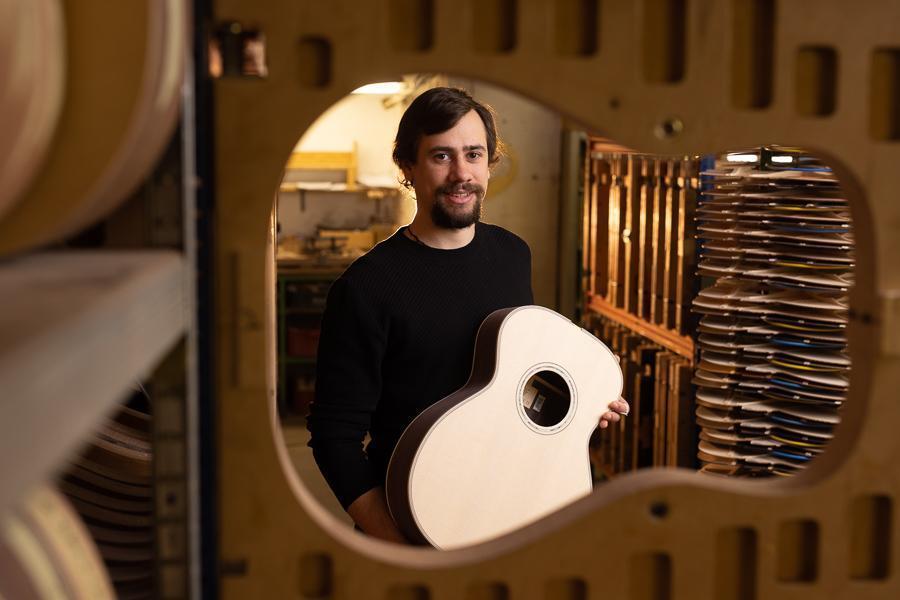
Some master’s theses remain stored in an information system after the defense. Others go beyond academia and find real-world application. Pavel Hoffman’s thesis clearly belongs to the latter group. What began in 2021 as student research at the Faculty of Electrical Engineering and Communication of Brno University of Technology (FEEC VUT) gradually turned into real prototypes of musical instruments and eventually into the author’s professional career at Furch Guitars.
In his master’s thesis, supervised by Ondřej Jirásek from the Department of Telecommunications (UTKO), Pavel Hoffman focused on innovating the top soundboard of a Dreadnought-type acoustic guitar. “I chose this type because it is one of the most widespread acoustic guitar models. Any change here has the potential to reach a large number of players,” Hoffman explains.
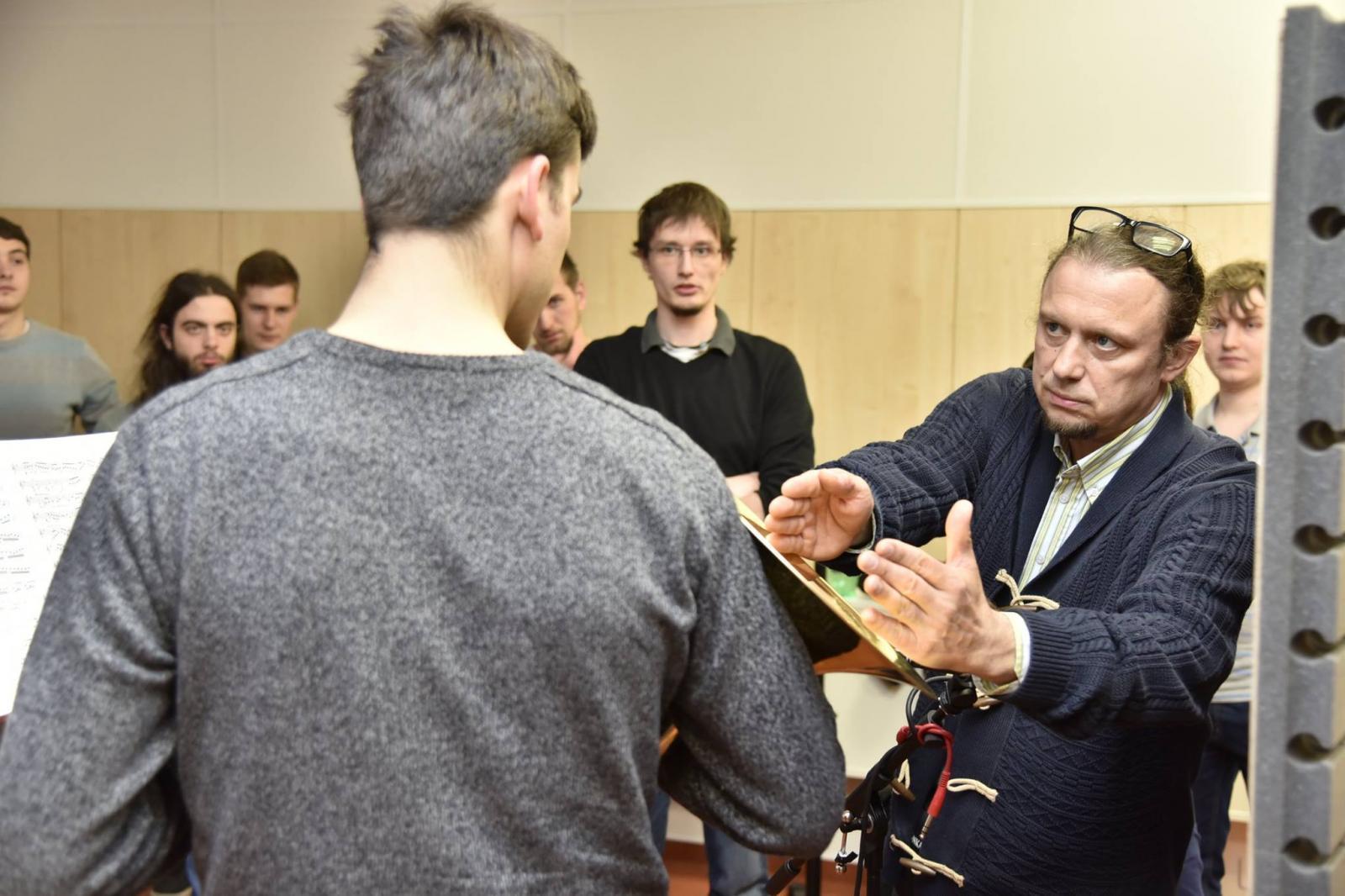
How the sound of an acoustic guitar is created
Simply put, inside every acoustic guitar there is a bracing system – a set of wooden struts glued to the inner side of the top soundboard. These braces have two roles: they reinforce the soundboard so it does not collapse under string tension, and they determine how it vibrates during playing. The way the top plate moves ultimately decides whether the guitar sounds full, resonant, and balanced, or dull with so-called “dead spots.”“I chose to modify the bracing because it is one of the most sensitive structural elements of a guitar. Even a relatively small change can have a surprisingly large impact on the sound,” says Pavel Hoffman.
When calculations meet wood
Before the first real instruments were built, most of the work took place on a computer. Numerical simulations made it possible to compare different design variants and estimate their vibrational behavior. “Numerical simulations allowed me to verify ideas before any wood was cut. This made it possible to focus the development and avoid dead ends,” describes FEEC BUT graduate Pavel Hoffman.Based on these calculations, prototype guitars were then created in cooperation with the Czech manufacturer Furch Guitars, where the results could be verified in practice.
From a thesis to Furch Guitars
The master’s thesis thus did not remain a purely academic experiment. Today, Pavel Hoffman works in the development department at Furch Guitars, directly building on the experience he gained during his studies at FEEC BUT. Starting from modest beginnings, Furch Guitars has grown into one of the world’s respected manufacturers of acoustic guitars. Its instruments are chosen by top musicians across genres, including Suzanne Vega, Al Di Meola, Per Gessle, Vlasta Redl, David Koller, and Aneta Langerová.When asked what he is currently working on, Pavel Hoffman answers: “At the moment, I focus on semi-automated wood selection based on physical and acoustic properties. I repeatedly encountered situations where suppliers evaluated quality only by appearance, not by how the material actually sounds. My goal is to introduce more precise selection so that truly high-quality material is chosen for the most expensive instruments.”
In addition, he is also involved in the development of new structural elements. One of them is the Booster Soundport, which is already part of top-of-the-line guitars today. “The Booster Soundport expands the sound radiation area of the instrument, modifies its directional characteristics, and brings a new playing experience for the musician. The resulting tonal spectrum is clearer, and the resonance of the top plate reaches higher performance,” Hoffman explains.
What studying at FEEC gave Pavel
Pavel evaluates his studies at FEEC very positively, even though he originally aimed in a different direction. “I started with the idea that I would one day become a sound engineer for concerts or film. But the diversity of the field was much broader than I expected, and it was in the analysis of musical instruments that I found my passion,” says Pavel, adding: “When people ask me what university gave me, I answer that it taught me how to search for information and work with it effectively. The most beneficial for practice were the final theses and projects.”Advice for future engineers
He also has a message for those who are hesitating whether to pursue technical studies: “Definitely don’t be afraid. I myself came from a secondary medical school, and most subjects were new to me. Still, it can be managed if you put in the effort. Studying technical fields gives you the opportunity to contribute to making the world safer, faster, simpler, or more entertaining. The hardest part is to start.”The findings from Pavel Hoffman’s master’s thesis were also published in a joint article with Ondřej Jirásek.
Source: FEEC BUT
Since he was a child, he dreamed of space. Now he wants to put the first student satellite into orbit
Award-winning Volteek project offers a modular battery management system developed through a student formula
Summer research programme at BUT inspired American students to pursue PhD
During a prestigious internship in Israel, a student of FEEC UT investigated the effect of anaesthetics on brain activity
A student from BUT founds OMG Robotics and changes the way computer science is taught in Czech schools