People
“A person doesn’t apply to study information technology because it’s easy,” says David Bažout, owner of Sensorie

What originally led you to choose university studies in information technology? Were you already passionate about computers and electronics in high school? Or was it more of a pragmatic choice driven by the prospect of a well-paid job?
I must admit that for a long time I didn’t know what I wanted to do professionally. I studied at a grammar school in Havlíčkův Brod, and even at the end of high school I had no clear idea of an ideal job. But technology itself always attracted me. My father is an electrician and showed me how to wire simple circuits at home. I also had a part-time job in the manufacturing and development of devices measuring water quality. So I had a sense of a basic technical direction.
Why did you choose the Faculty of Information Technology at BUT for your further studies?
Because I come from a village and moving away was a significant challenge for me, the choice of city played a major role. Brno seemed like a great option because it’s calmer than Prague. I applied to BUT and CTU, and I think also to Hradec Králové, but that was more of a backup. In January I attended an open day and really liked it. Based on the SCIO tests, I was accepted to FIT, and after that there was nothing more to decide.
Was the first year a challenge for you in any way? Did you have to quickly catch up on anything?
Of course it was a big change. You have to function in a larger city, take care of everyday matters—shopping, housing. But the university style of teaching suited me quickly because it gives students autonomy in decision-making. The higher level of responsibility appealed to me. When I came to Brno, I had only written a few short “source codes.” I had to devote myself fully to my studies; in my first year I was more of an average student. From grammar school I brought solid theoretical foundations in physics and mathematics, and I had also assembled a few circuits and devices myself—for example, my own solar power plant. Practical experience came in handy at FIT. As for time demands: I had to combine my studies with a part-time job and work, I needed to support myself. It was hard work, but still within bearable limits. After all, people don’t apply to study information technology because it’s easy…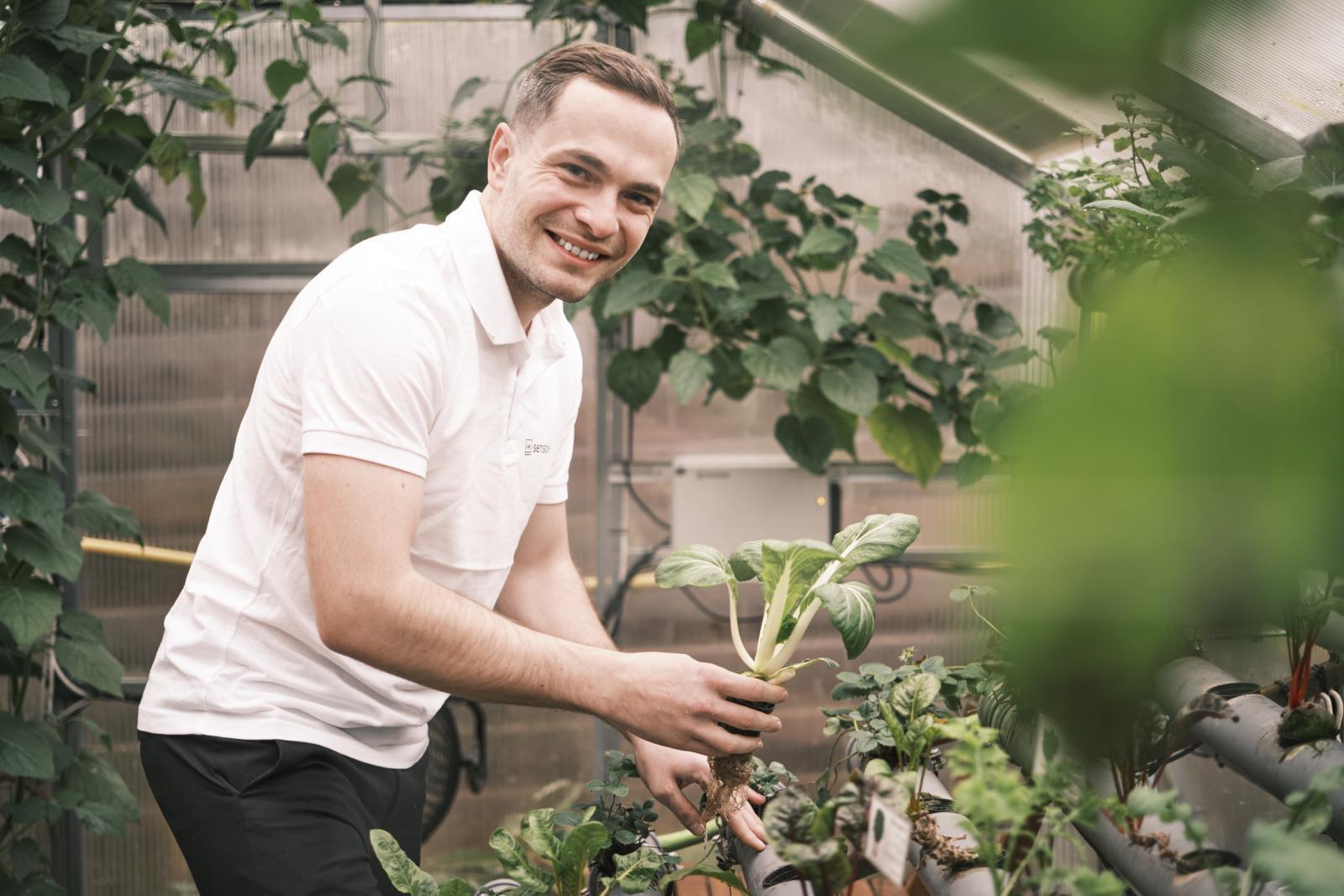
I agree. I noticed your name in connection with the faculty event Excel, a conference of student projects and innovations, many of which later turn into concrete business ventures. Was your idea—later crystallizing into founding Sensorie and starting a business—already forming during your studies?
In 2019, I participated in Excel with two projects. One was essentially my bachelor’s thesis, the other I can truly describe as the initial seed of Sensorie. It had no specific application at the time; it was generally a custom automation system measuring industrial process values using sensors and reacting to them. You see, I always wanted to see meaning behind my work. Without it, even high pay wouldn’t save it. Sooner or later it would start to eat away at me. At the faculty, in cooperation with the JIC innovation agency, activities supporting student entrepreneurship emerged. They were optional, without credits, but I grabbed the opportunity. There are no entrepreneurs in my family; I didn’t have a close relationship with business from home. It was only thanks to the courses that I started thinking about it more. With the help of the faculty competition Star(t)up@FIT, my colleague and I obtained initial financial support. That motivated us to continue working on the project. I remember it was the summer holidays after my bachelor’s degree, in 2019, and we were thinking about what to do next with the project—and also about the feedback from the competition committee, which pushed us to find a concrete field of application.
How did you actually come up with the idea of smart greenhouses? I imagine that the entire cultivation sector is a conservative world that tends to view new technologies with skepticism.
We were sitting on a bench in a park once—maybe it was Denis Gardens—and it occurred to me: what about building a smart greenhouse? My parents in the countryside grew vegetables; I saw greenhouses all around me. My father was very busy timewise, so he was looking for a way to simplify greenhouse operation, but it was always quite a struggle… And suddenly it all came together nicely in my head: use the knowledge from my studies, work on something socially beneficial, get back to tinkering with technology, and try entrepreneurship. And that’s how Sensorie was born. But that doesn’t mean I gave up my studies after my bachelor’s degree. I completed my master’s degree and even started doctoral studies. However, at that stage I already missed real-world impact; a conference paper couldn’t replace the feeling of completing a real project. I never turned my back on science or academia—but I simply do research within our company.
I understand that the journey from the initial idea to the current form of the company was one that you couldn’t have fully imagined at the beginning.
Fortunately. I have a trait of not thinking things through to the very last detail in advance. I rely on intuition and throw myself into things wholeheartedly, headfirst. If I had realized everything that awaited us, I wouldn’t have gone into business. In 2019, when we started, people around us sometimes shook their heads and said: “A smart greenhouse? That belongs in an industrial hall, not in a backyard garden.” Or: “Growing in winter—what nonsense, everything will freeze!” On top of that, demanding university studies, student-level financial resources, a situation where you have to invest a lot long before the project starts earning money, and enormous responsibility… We built the first prototype in two weeks in my parents’ garden, but the path from a prototype to a product you ship to a customer in a box that works under all conditions—that’s two weeks plus five years of development. It’s the classic “ninety percent done” syndrome. Bringing a product to the finish line and making it user-friendly is a major challenge. And in our case, you also have to account for customers who know nothing about cultivation or technology.
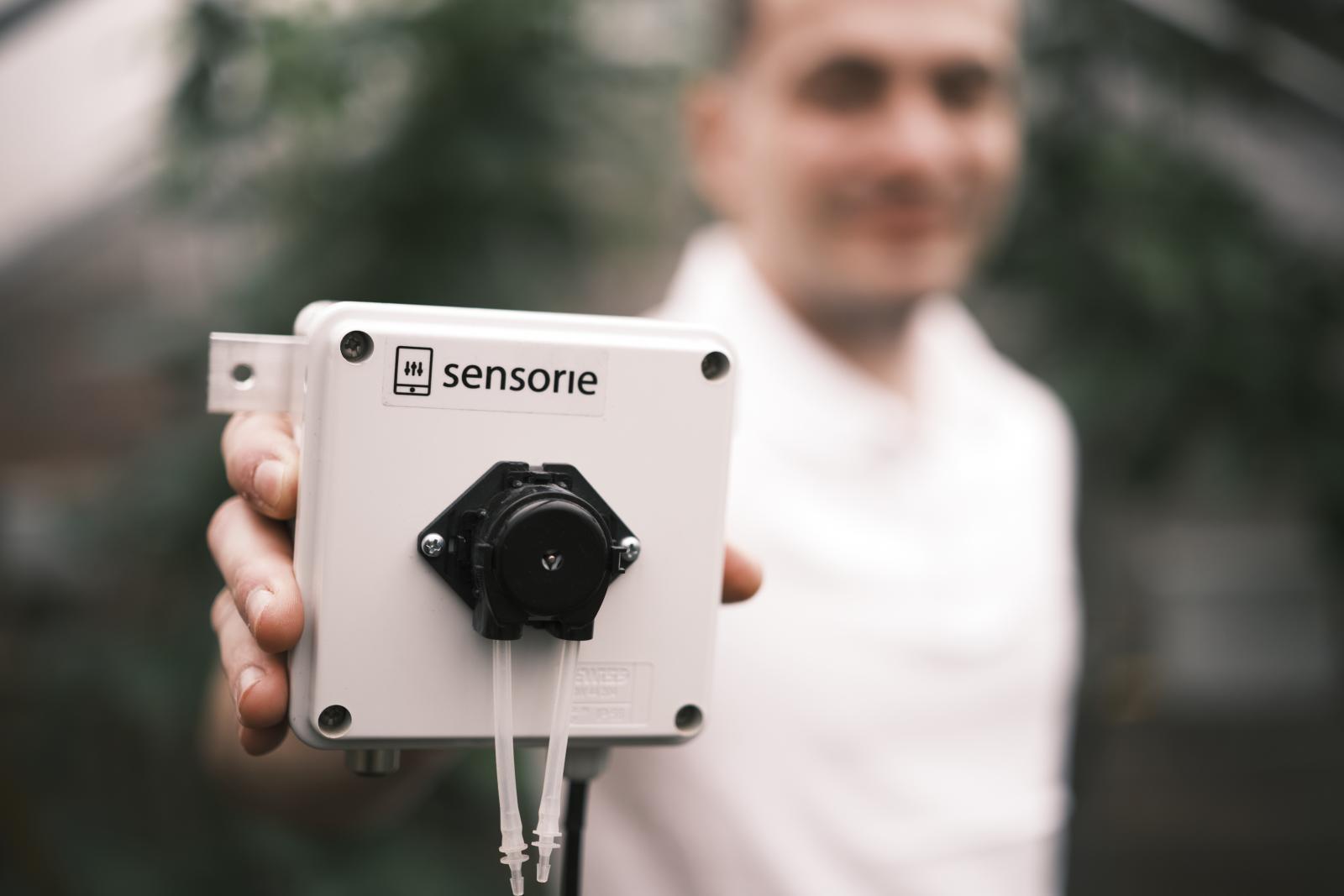
Today you offer not only smart technology kits for self-assembly, but also turnkey greenhouse construction. It seems that the demanding journey has paid off.
When we started, our maximum offering was to provide equipment. Gradually, we gained manufacturing partners, although convincing traditional greenhouse manufacturers of the benefits of cooperating with us was challenging. After all, there are many student projects, and horticulture is a conservative field that honors tradition—just as you said. Today, we have completed roughly 250 installations. Business success is not only the result of good decisions, but also of factors you cannot control. I mean things like timing, the financial situation of partners, or simply luck in contacts and recommendations. Take COVID, for example. In the short term, it really threw a wrench into our plans: canceled exhibitions, a newly completed demo greenhouse in Brno that we couldn’t invite anyone to see, disrupted supply chains. But on the other hand, in the long term COVID shifted society’s mindset toward self-sufficiency, which actually played in our favor. You have to respect that life deals the cards, and we have to know how to play them. Today, greenhouse manufacturers approach us themselves, seeing our products as added value to their offerings. And I truly believe that value is there. With our greenhouse, even a complete beginner can have a year-round supply of healthy home-grown vegetables, fruit, or tasty fish meat. This is also confirmed by the fact that in the last six months we have built greenhouses with a cumulative value equal to that of the previous six years combined. In business, perseverance is essential.
When you look back at your studies and career: where do you see the contribution of FIT to your professional path? And where was studying at this faculty a challenge? What obstacles did you have to overcome?
Access to knowledge about entrepreneurship was extremely important to me. And then, of course, hard skills—to this day, I am the only software developer at Sensorie. The knowledge you gain at FIT has a broad scope. You gain general awareness across many subfields. FIT also taught me a certain way of thinking that helps me today in managing the company. I try to divide problems and projects into modules with functions—essentially a reflection of technical thinking. As for major challenges: I didn’t need to study for the title; what’s on paper doesn’t matter—what matters is what a person can do. During my studies, there were moments when I searched for motivation to continue. And in that regard, activities aimed at developing entrepreneurship were crucial for me. They came at exactly the right time.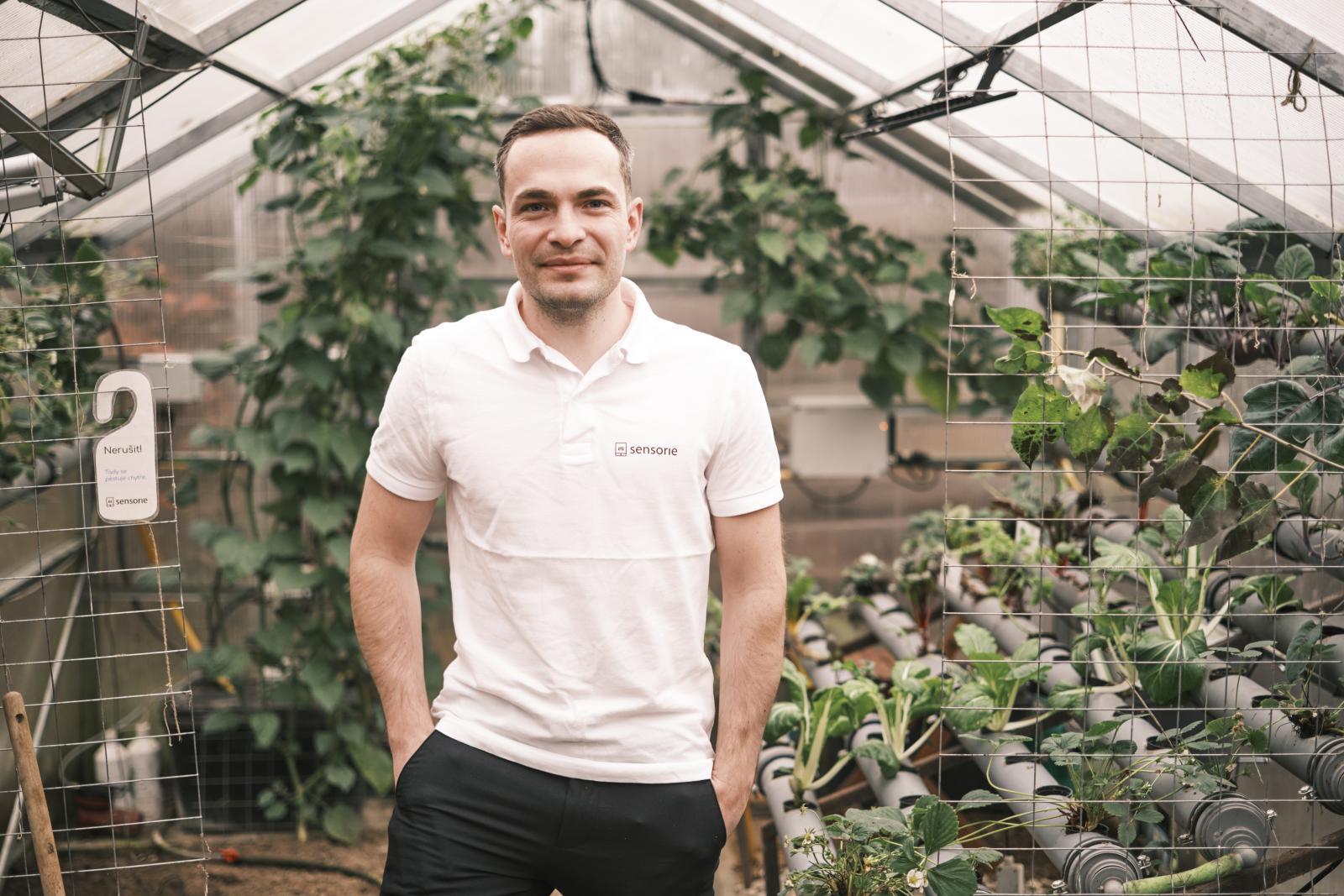
David Bažout has written his life and entrepreneurial journey into book form. The official launch of the book “The Boy Who Builds Smart Greenhouses” will take place on February 25, 2026—exactly five years since Sensorie obtained certification and shipped its first smart greenhouses. More about the book, including ordering options, can be found here.
Ing. David Bažout, a graduate of FIT BUT, wrote his diploma thesis on an image processing topic, “Detection of Anomalies in Crowd Behavior in Video Data from a Drone.” In the summer of 2019, he came up with the idea of building smart greenhouses, which in recent years has evolved into the highly successful company Sensorie, of which he is the founder and director.
Source: FIT BUT
Sensorie greenhouse wants to make growing vegetables at home the norm. It offers smart solutions for year-round harvesting
Device is being developed at strojLAB that students hope will help them succeed in a prestigious biotechnology competition
Adam Herout: I enjoy connecting the world of atoms and bits
They wanted to teach English. In the end, they are "raising" new IT specialists and preparing a revolution in education
VeriFIT: a successful research group. Not just at the Computer-Aided Verification conference