People
BUT graduates are behind successful startup coworkers.ai, which is changing world of customer support
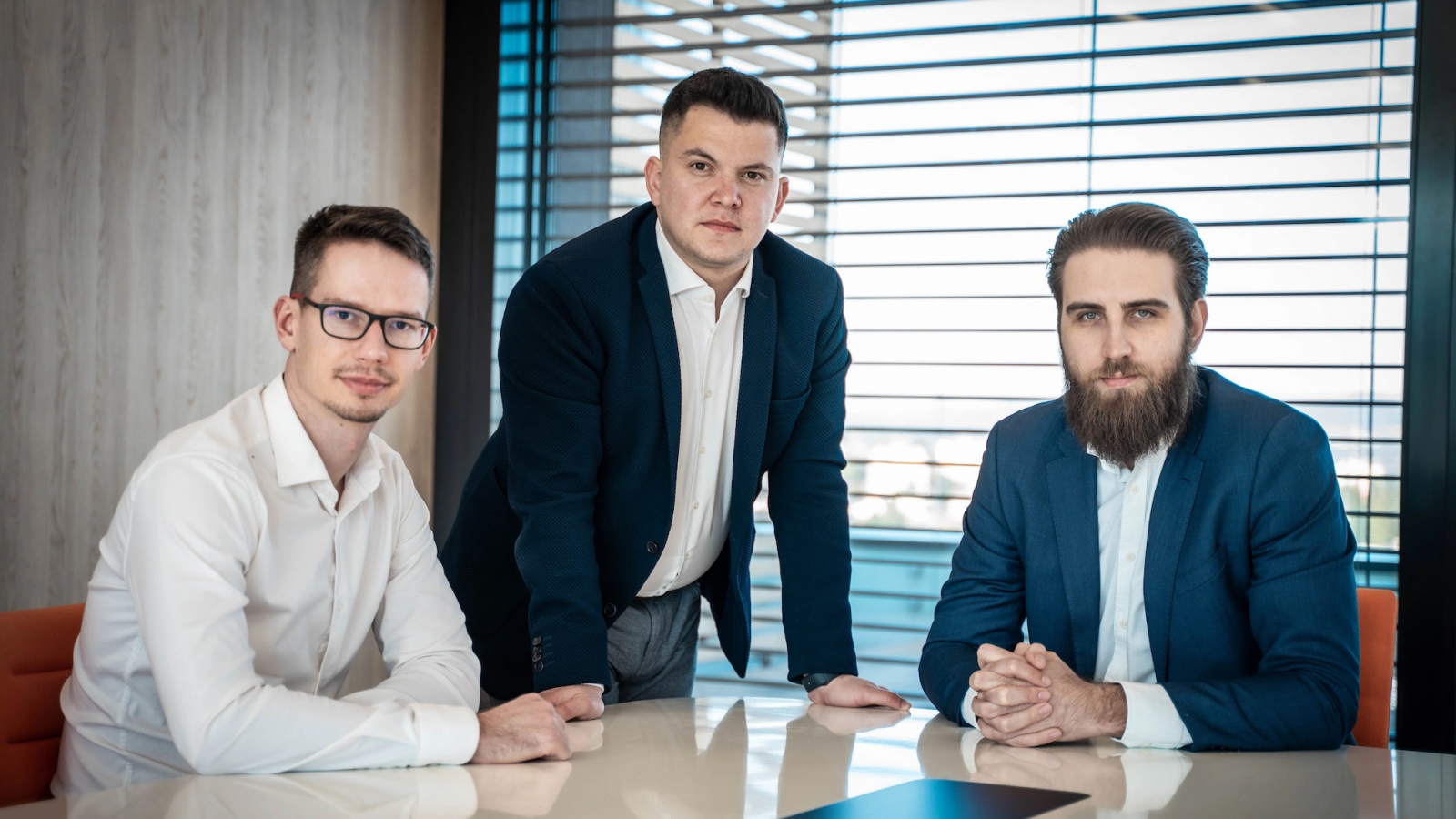
They started out as ordinary students at the Faculty of Information Technology BUT – one of them almost dropped out after the first year. Today, both stand at the helm of the successful Czech startup coworkers.ai, which helps companies automate customer communication using artificial intelligence. Among dozens of their clients are, for example, Generali, Rossmann, Seznam, and Czech Television. Tomáš Lysek and Pavel Černý talk about how studying at BUT opened the door for them to technology and the courage to do business, how their first chatbot was created, and why they believe it is crucial to stay in touch with the university even after graduation.
How did studying at BUT contribute to your success?
Tomáš: To a great extent. In my first year I was a “standard student” :), on the verge of being expelled. I spent whole days playing games, eating steaks (even three times a day) from Pizzeria Pod Palačákem, and drinking beer at Terč. I was almost expelled after both the first and second semesters, gained 20 kilos in half a year, and told myself, like everyone else, that the school was so hard that I would never get “A” grades and couldn’t anyway. For my bachelor’s thesis I had an excellent supervisor (Pavel Zemčík), and I put absolutely everything into it. In the end I got an A for it and also an A in the state exam. And I thought to myself—was I wrong? Did I waste three years of my life and could I have taken more from it?
On the first day of my master’s studies I told myself: I’ll give it everything and I’ll graduate with honors. I gave it everything and I did graduate with honors. The most important thing the school taught me was the determination to achieve a difficult and “unattainable” goal and to reach it in two years despite all obstacles. Of course, it also gave me a lot of fundamentals that I still draw on today (thanks to the fact that I attended lectures and didn’t watch them at 1.5x speed right before the exam :)).

What problems do you help companies solve?
Tomáš: We develop robots for chat, phone, and email channels. With clients, we always first analyze their existing communication and based on that select scenarios suitable for automation. We therefore developed an AI tool where we input all of a company’s communication and on the other side get a hierarchical overview of query types and their quantities. Thanks to this analysis, we can then focus only on the queries and cases that make sense. We provide this analysis free of charge as part of every installation. We already have more than 300 implementations behind us, and our clients include, for example, Generali Česká pojišťovna, Rossmann, Ticketportal, Czech Television, Zásilkovna, or Knihy Dobrovský.
Pavel: In addition to automating routine queries, we have also developed a product advisor that helps customers choose products in an e-shop. It can find and recommend the most suitable products and guide customers through the purchase, while also increasing sales and the overall value of purchases through smart recommendations.
What was the initial impulse behind the idea to found a startup, how did the idea itself come about, and how did it become a functional product?
Pavel: It all started years ago at Artin, a company focused on custom IT projects. When we weren’t working for clients, we devoted ourselves to internal ideas. Our first commits date back to 2017; at that time it was a simple web chat. A year later we acquired our first customer. However, it was still more of a side project, development wasn’t stable, and the team changed frequently. In 2020 I returned as lead developer and things started to move significantly. The number of customers grew, but we were not yet in the black. A year later, Artin began looking for an investor and we agreed on a spin-off. In 2022, coworkers.ai was founded—with greater freedom, but also much greater responsibility. The beginnings were not easy and the entrepreneurial risk was considerable, but we managed it. And today? We are maintaining double-digit growth year on year.
What is coworkers.ai’s approach to combining research, development, and business?
Pavel: Every startup has to pay for itself eventually, so business must always come first. At coworkers.ai, however, we are fortunate to have CEO Tomáš Lysek, who is also a “graduate” of BUT and someone who is very close to science. Thanks to this, we are able to combine a business perspective with a technical and academic approach. We therefore work with the latest technologies, especially in the areas of natural language processing (NLP, LLM) and speech processing (TTS, STT). This ensures that our products not only make business sense, but are also built on cutting-edge technologies and have a long-term perspective.
What is your vision for the future?
Tomáš: I think there will be more and more conversations automated by robots. Five years ago, we couldn’t even imagine that a robot could “just” crawl websites and answer frequently asked questions with 98% success—that’s something we managed to achieve, for example, with Seznam on the Sklik helpdesk. In another five years, I believe AI in customer support will be at such a level that an average customer won’t even recognize it.
Pavel: Our main challenge for the coming year is a shift towards SaaS (Software as a Service – a model of providing software over the internet on a subscription basis – editor’s note). This includes adjusting the product, introducing a new payment model, and creating a “lite” version for a broader range of customers. At the same time, we are planning a complete rebuild of the on-premise deployment so that it is as close as possible to our cloud deployment.
What would you recommend to fresh BUT graduates?
Pavel: IT is, and always has been, a very dynamic field, so I recommend experimenting with and following the latest technologies. Enthusiasm for new developments is reflected in subsequent work and motivates the entire team to achieve better results. Another piece of advice would be not to forget, in addition to programming, DevOps (an approach to software development that combines development and IT operations – editor’s note) and networking. I am convinced that knowledge in these areas is useful almost always. Some graduates look for a calm and stable environment in a corporation, while others prefer “punk” and agile development in startups. The key is for everyone to choose the path that suits them best.
Tomáš: After school, I think the most important thing is not to fall asleep and to keep educating yourself. School taught you how to learn, and if you want to do interesting work, you will be learning all your life :). I recommend finding something you enjoy, something you see meaning in, and improving in it. It’s also good to realize that after school many people don’t yet have commitments (spouses, mortgages, children), and that this is precisely the best time to start working on a career or a business. I also think it’s great to stay in touch with the university and other alumni. You have access to laboratory facilities, technologies, and a lot of interesting information. You never know when it might come in handy. VUTAlumni.cz, for example, is a great way to stay informed and connected.
Even in a highly competitive environment it is possible to build a successful global company, the founder of codasip Karel MAsařík tells students of BUT
They wanted to teach English. In the end, they are "raising" new IT specialists and preparing a revolution in education
Sensorie greenhouse wants to make growing vegetables at home the norm. It offers smart solutions for year-round harvesting
Matúš Nosko: "Don't be on your own—neither in your studies, nor in your business."
Women from BUT who move the world of science and technology