People
Ondřej's career path led from internship in space industry to ESA
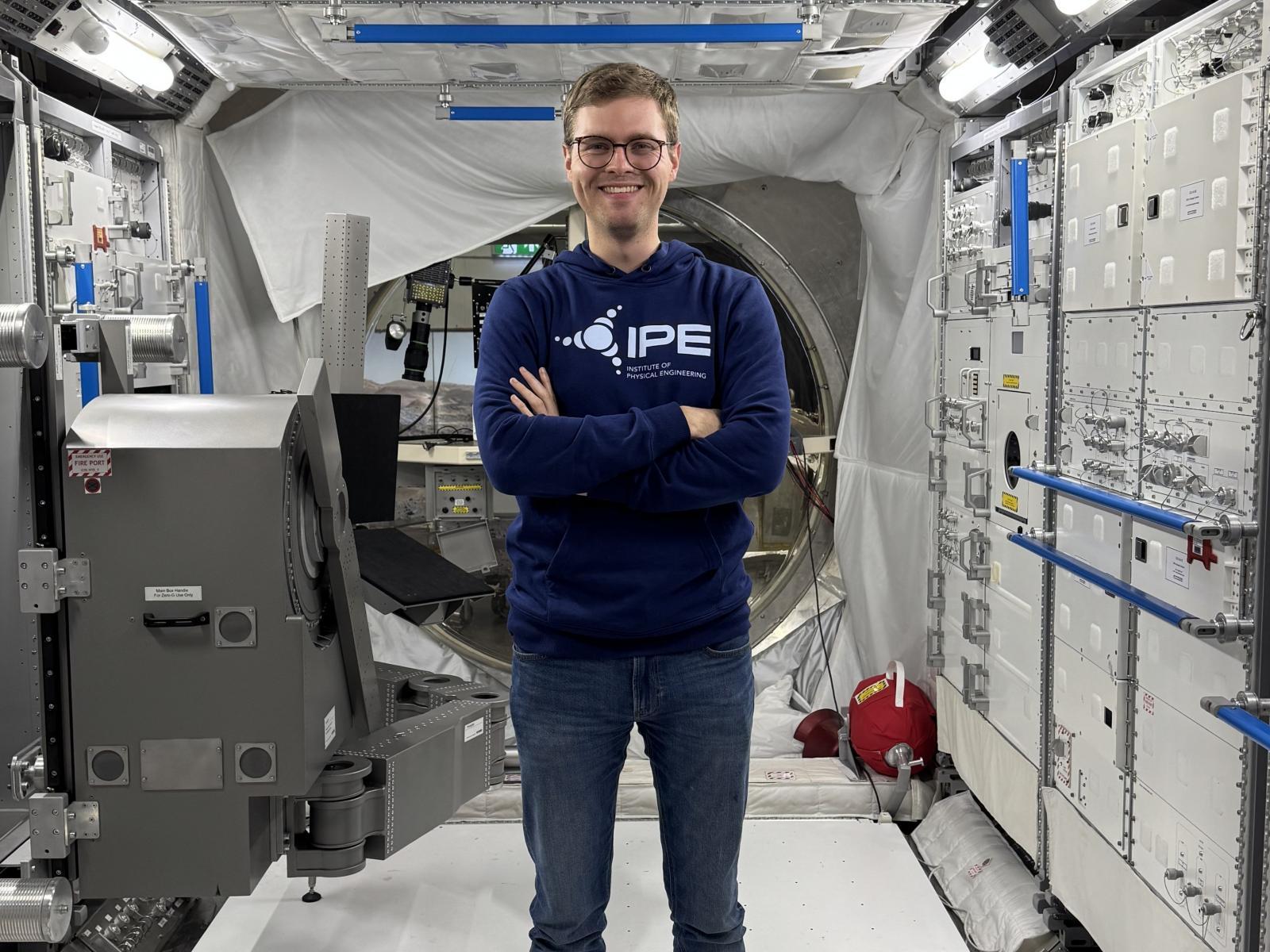
Almost three years ago, you could read an article about Ondřej Šlajs (only CZ) on the FME website. At the time, he was a bachelor’s student fascinated by space technologies who applied on his own for an internship at OHB Czechspace. And today? He is a successful graduate who started working this autumn at ESA’s Dutch headquarters. What was his journey to the stars like?
When we last spoke, you weren’t even sure which master’s programme you would choose. Now you are a successful graduate of Precision Mechanics and Optics, and we are speaking via video call because you are sitting in the main development centre of the European Space Agency…
That’s right. I have been working since October at ESTEC, ESA’s development centre in Noordwijk in the Netherlands, roughly halfway between Amsterdam and The Hague. I work on so-called performance models. That means I try to simulate what an optical system sees: from what it captures to what it ultimately displays. So it’s optics, which I studied, but combined a bit with programming.
How can a fresh graduate get a job at ESA?
My position is called ESA Graduate Trainee. I have a two-year contract; I’m a regular employee, but the position is specifically intended for graduates with a maximum of one year of work experience after obtaining their master’s degree.
Getting the position isn’t exactly easy – it helps to have interesting internships or projects behind you. My work at OHB Czechspace and my internship at the German OHB certainly helped, where I worked on the PLATO mission, which is directly an ESA mission. It also depends on the specific topic of the advertised position.
At the same time, it’s important to say that ESA follows the so-called “georeturn policy”. This means that each member state contributes a certain amount to the agency’s budget, and this ratio is then reflected in the level of that country’s involvement in projects and also in the number of employees hired.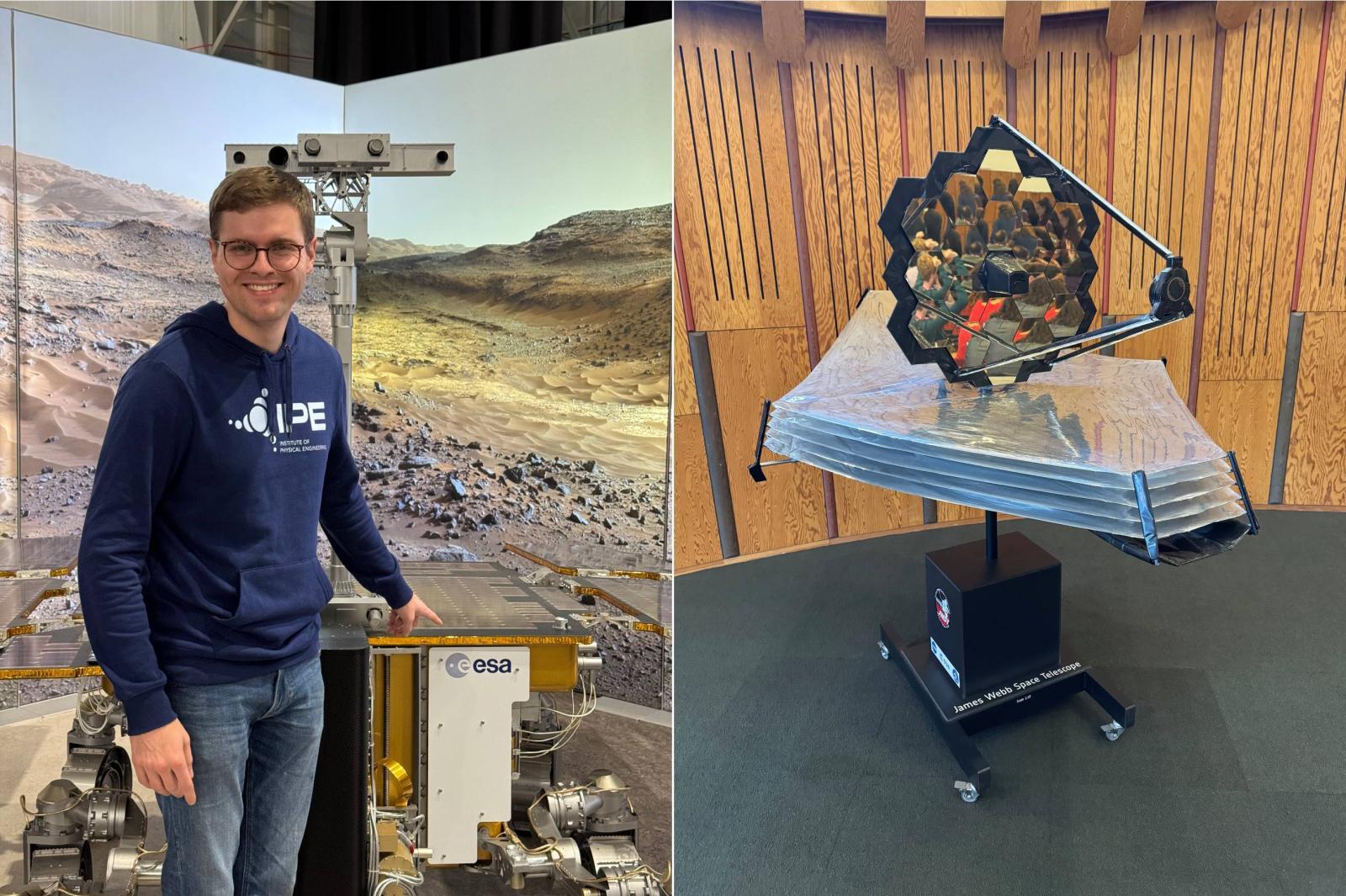
Do you have a mentor as a trainee?
I have a supervisor who can be compared to a thesis supervisor: I share my work and progress with him and can consult him whenever needed. You apply for the ESA Graduate Trainee programme for a specific position with a defined topic that you then work on. And each trainee – because there are more of us here – has their own supervisor, so you’re not on your own.
You had your eye on a career in the “space” sector already during your bachelor’s studies. I assume that influenced your choice of follow-up studies?
I tried to connect the two. There were several options at FME – for example aerospace engineering, mechanics, or physics. In the end, physics, or rather optics, won. At the time I was working at OHB Czechspace, whose German parent company develops optical systems for space. I saw that as the future, because not many people in the Czech Republic focus on this field. So while my bachelor’s thesis was about dental implants, my master’s thesis focused on developing a test collimator for a satellite telescope.
Paradoxically, my master’s studies were less demanding for me than my bachelor’s. Probably also because there were great people at the Institute of Physics and I truly enjoyed the studies. Thanks to that, I was also able to continue cooperating with OHB Czechspace throughout my follow-up studies and stayed there until I received the offer to work for ESA.
I believe working at ESA is a dream come true for you. What is the reality like?
There are amazing people here! Extremely interesting, true experts in their fields. With my focus on optics usable in space, it’s even better, because in the Czech Republic this field is not very developed, so there aren’t many opportunities to learn from others. Here, you can absorb information every day – sometimes I even feel it’s too much and I have to pace myself. ESTEC is a central hub where everyone gathers, so there are conferences, international schools, workshops, etc. We have the opportunity to attend these events.
I sit in an office with six young researchers. The entire ESTEC is multicultural: there are Germans, French, Italians, Spaniards, Irish… ESA has 23 member states, and there are people from each country here, which is great.
Is ESTEC more like a world of its own, or do you manage to live a normal life alongside work?
You live a completely normal life here. You have to find accommodation, deal with administrative matters, get to know the surroundings, and make friends. You simply moved abroad for work. Finding accommodation here is really challenging; I was looking for two months. Fortunately, ESA has a Housing Officer who helps people find housing. He recommended landlords who wanted to rent out a house, and luckily it worked out. I moved with my girlfriend and our dog. We live in a house in the suburbs. You just shouldn’t dwell too much on how much you pay for rent, because that can be quite painful.
Do you meet other people from the Czech Republic at ESTEC?
Yes, I think there are about fourteen of us here. We sometimes go for lunch or a walk together. There’s even a pub directly on the ESTEC premises, so we go there for a beer as well. (laughs)
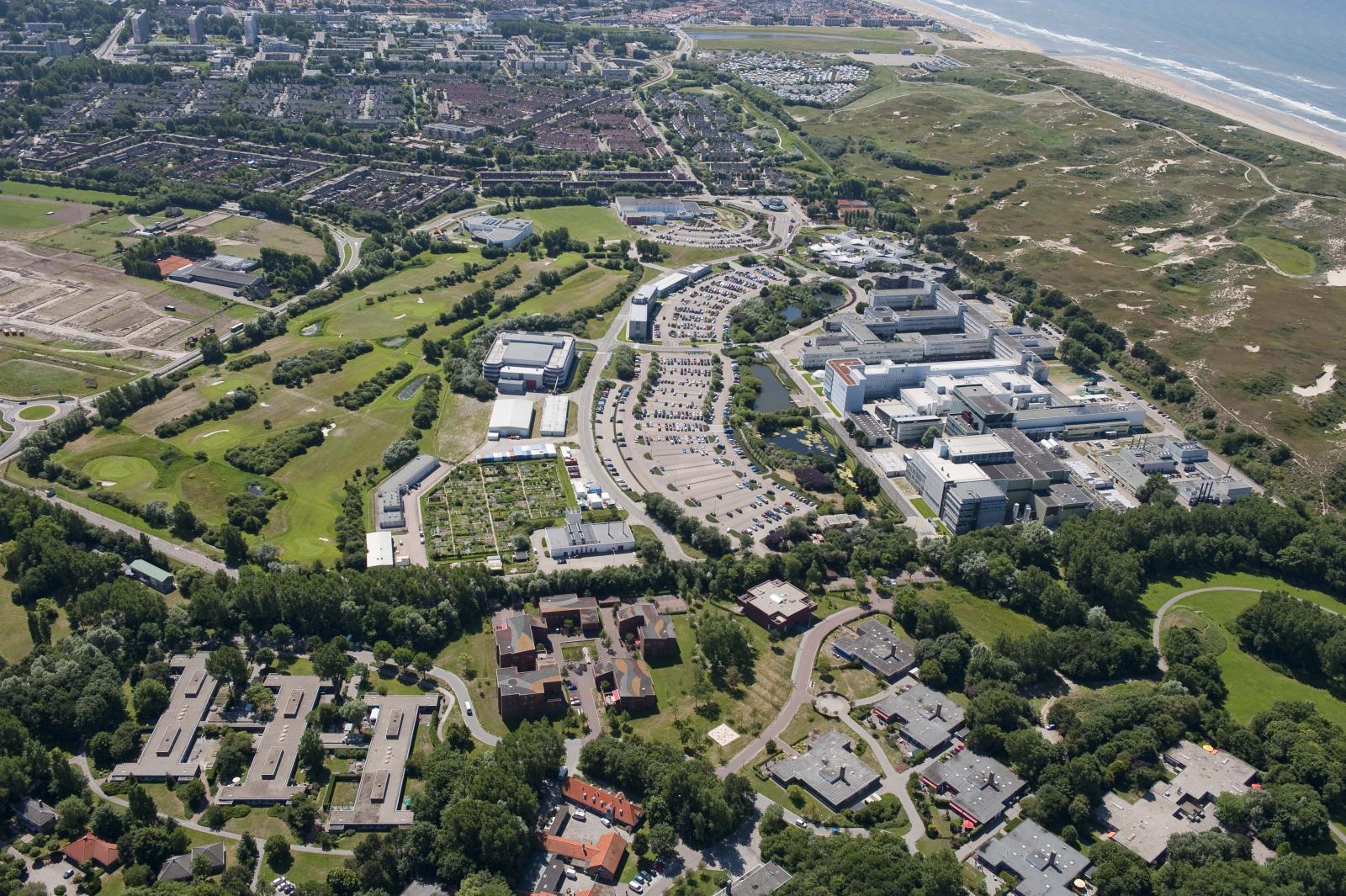
You mentioned this is a one- to two-year position. What happens next? Can you stay at ESA?
The Graduate Trainee programme doesn’t assume that you will stay. The idea is rather to train the next generation of engineers who will then move on to companies. So we’ll see where I head next. Of course, it’s not just about my decision. I’m here with my partner, so we’ll work it out in a way that makes us both happy.
You mentioned that you work on performance models. Will you also get involved in a specific upcoming mission?
I verify my models on the ECO – Earth Climate Observatory mission. This mission is currently in an early phase and aims to measure the Earth’s energy balance. The satellite will measure the total outgoing radiation of the Earth and the total incoming radiation from the Sun. Earth’s radiation will be measured using cameras in different spectra (VIS, SWIR, TIR) and a radiometer. Solar radiation is measured only by a radiometer. The difference between the radiation received by the Earth from the Sun and the radiation emitted by the Earth is positive, which is why global warming occurs. If we understand this trend well, it will be possible to predict global warming over a longer time horizon. It’s great that I can work on a specific mission where I can test and validate these models.
What do you enjoy most about optics?
What I enjoy most is the complexity of the problem. Optics is fascinating also because imaging results can be significantly influenced not only by the optical design itself, temperature, and mechanical mounting, but also by observation parameters. With performance models, I try to calculate and verify precisely these imaging parameters. Many variables enter these calculations – some of which I didn’t even know before – so you can really dive deep into it and keep learning. That’s what I enjoy about it.
Source: FME BUT
"I enjoy innovating established products. Potential lies in electronics and software," says Pavel Schiller from ASN Plus
“An astronaut doesn’t have to be the best person in the room,” says cadet Tereza Bednářová
I don't call the students by name, I respect them very much, says Šárka Mikmeková
Optical fibres will help peek into the deepest parts of the brain. A doctoral student from FME is involved in the research
The market was lack of clothing for tall people, so Radek Pilař started sewing his own