People
Story of Professor Dinara Sobola: From First Experiments to Professorship
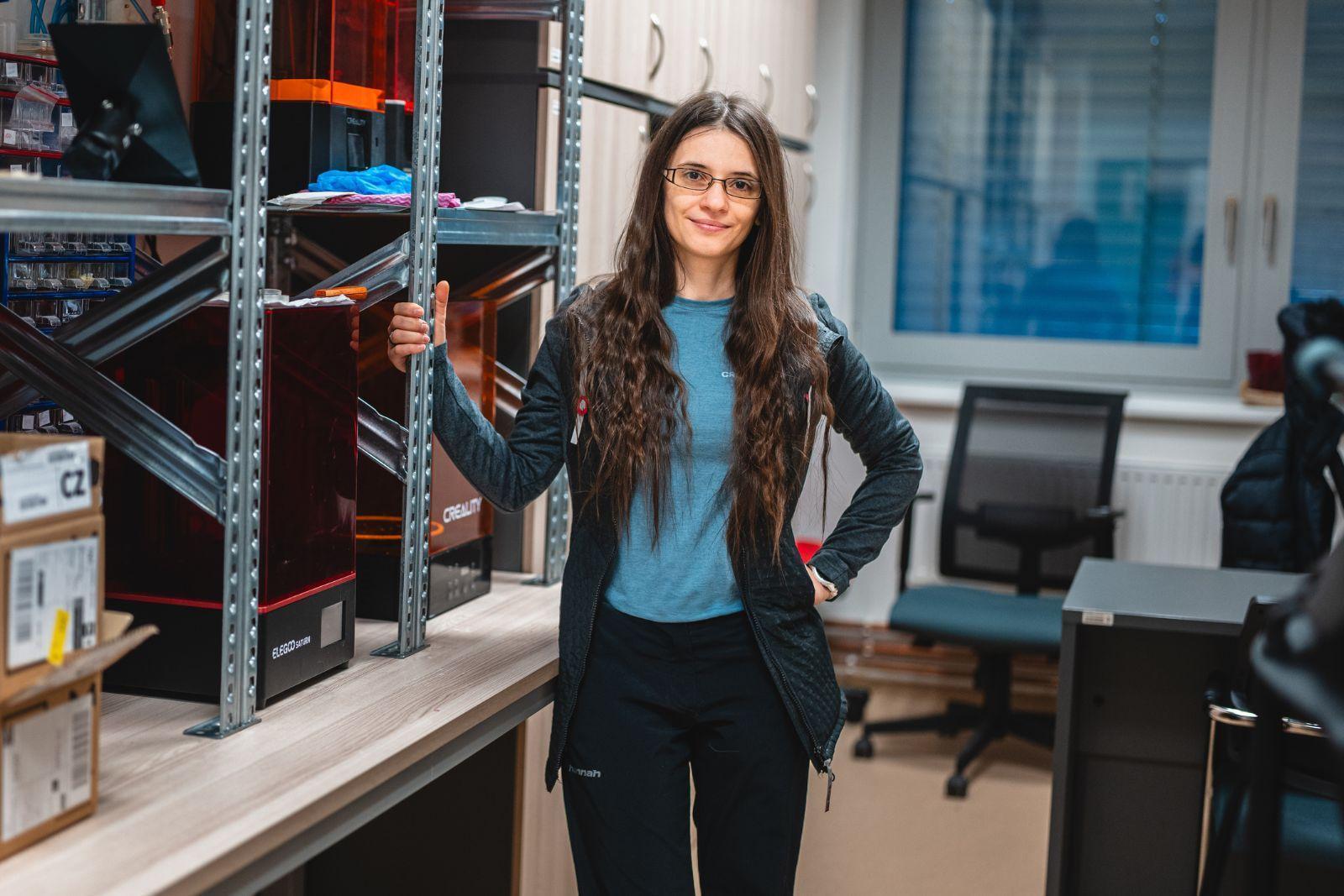
In December, Professor Dinara Sobola defended her professorial work before the Scientific Board of Brno University of Technology, and on 1 June she was appointed professor by the President of the Czech Republic. Yet her career did not unfold according to a predetermined plan — it developed naturally alongside her interest in experiments, materials, and laboratory work.
Dinara Sobola works at the Department of Physics of the Faculty of Electrical Engineering and Communication (FEEC) and also at the Institute of Physics of Materials of the Czech Academy of Sciences. She became acquainted with the academic environment very early. While still in secondary school, at the age of seventeen, she began working at a university as technical support in a laboratory. She prepared samples, looked after laboratory equipment, polished instruments, and learned the basics of experimental work. It was then that she formed the close relationship with the laboratory that has stayed with her to this day. These practical experiences led naturally to her subsequent university studies at Dagestan State University. "For me it was quite natural," she says, adding: "I have always enjoyed science."
From Dagestan to Brno: A Decision Made at a Conference
A turning point in her career came during a professional conference in Prague. At the time she was actively looking for a workplace where she could continue her scientific work. "I had three places in mind," she recalls. It was in Prague that she met her future supervisor, Professor Tománek, who organised the Photonics Prague conference. "And it was settled," she says with a smile. "As soon as I finished my master's studies in Dagestan, I started my doctoral studies here, at FEEC. The key factor in my decision was that it allowed me to work with better equipment in the field of non-destructive diagnostics."
The move to the Czech environment also brought a linguistic challenge. Although Slavic languages are close to one another, English was — and still is — easier for her in technical communication.
Research: From Optics to Smart Materials
In her research she built on topics she had already pursued during her studies and gradually expanded them. She began in optics, but later turned her focus to advanced materials with a complex internal arrangement — so-called smart materials. "I am interested in the material base for new types of computers and sensors," she explains. "Materials whose arrangement could mimic the structure of human neurons and find application, for example, in artificial intelligence."
These materials have a wide range of uses — they are applied in sensors, chips, and detectors, as well as in medicine and energy storage. "I believe that one day it will be possible to make full practical use of multiferroic sensors, particularly because of their high sensitivity, low energy demands, and ability to detect several physical quantities at once."
The Laboratory as a Daily Reality
Professor Sobola's work is firmly tied to experiments. Her laboratory resembles a classic chemistry workplace: gloves, test tubes, vials of substances, the mixing of compounds, and the synthesis of materials. She then processes the resulting structures using 3D printing and tests their electrical, mechanical, and magnetic properties. "We synthesise a material, make a part, and then test how it behaves — for example, how its conductivity changes in an electric field, or how mechanical stress affects the magnetic response," she describes. Part of her work takes place in the clean rooms of the CEITEC BUT research centre, where she also serves as the guarantor of one of the instruments and has round-the-clock access to the laboratory facilities. As she adds with a smile, while the experiments are a joy, recording them calls for more patience: "We go into the lab smiling; we sit down at the computer a little more seriously. But when you love the work, in the end you come to enjoy the writing too."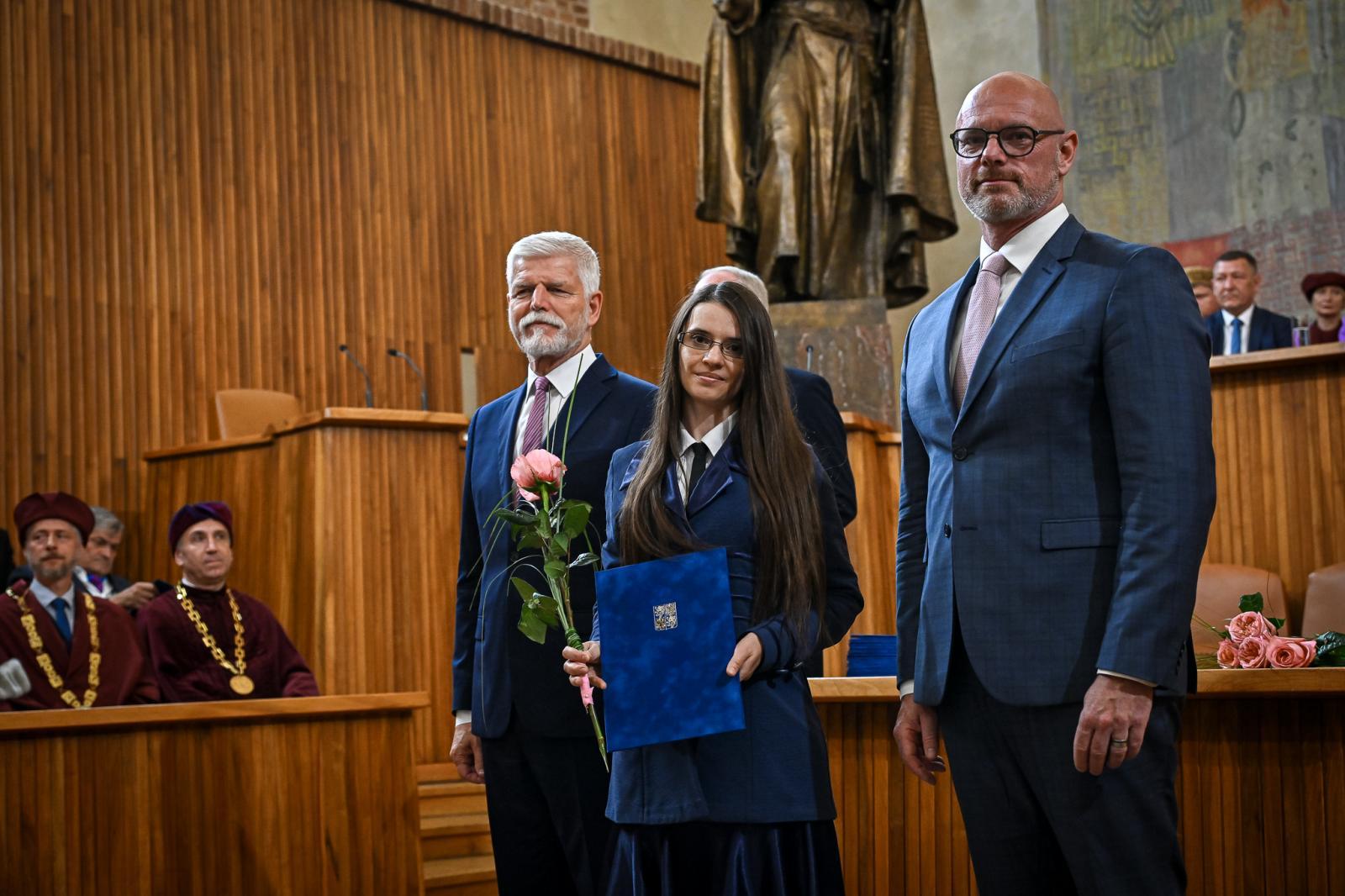
International Collaboration and a Personal Decision
Professor Sobola's research has a strong international dimension, particularly towards the United States. After completing her doctorate, she planned a one-year postdoctoral stay at the University of Washington. Just a few months before her planned departure, however, she met her current husband at a Japanese anime festival. She did travel to the United States for the research stay, but by then she already knew she had found her life partner. After a few weeks she therefore returned to Brno, married, and started a family.
Collaboration with American partners continues to this day — through student exchange visits and doctoral internships, as well as regular participation in international conferences. In the Czech Republic she works closely both with the aforementioned Czech Academy of Sciences, specifically with the Institute of Scientific Instruments, and with the Faculty of Science of Masaryk University.
Behind Every Successful Scientist Stands a Patient Partner
Alongside science, her life also includes family, including two small children. She has remained in continuous contact with the world of science, and her return to work after parental leave was very quick. Her husband, by contrast, took a career break. "The most important thing is to find the right life partner. You could say that the life partners of us scientists have a halo — they have to cope with our mood swings when an experiment fails and we keep mulling it over," says the newly appointed professor. And where do the best ideas come from? "Often in the bath," she adds with a smile.
Next Stops: The USA and Japan
In addition to research, Professor Sobola also teaches the courses Solid State Physics and Physics in Electrical Engineering. In the near future, foreign trips await her, including both shorter and longer stays in the USA — in South Dakota — and in Kyoto, Japan, where she will work on testing multiferroic-based sensors.
The story of Professor Dinara Sobola shows that top-level science grows out of long-term dedication, perseverance, and the joy of experimentation — and that the path to a professorship can begin inconspicuously, perhaps with the washing of beakers back in secondary school.
Related: From nanotechnology to civil engineering: BUT has eight new professors - News – BUT
Source: FEEC BUT
Women from BUT who move the world of science and technology
100 years since the birth of Josef Dadok, pioneer of instrumentation technology
Scientists from FEEC BUT are participating in the development of a smart intersection. This could make transport more efficient and ensure greater safety
Miroslav Kasal: Experimental radio electronics is my life's credo
YSpace succeeds in prestigious ESA programme and heads to space