Automating 3D printing to help companies operate their printers faster and more efficiently. That was the idea put forward by Miroslav Pejř from the Faculty of Mechanical Engineering BUT (FME). The expert jury liked it so much that it earned him third place in the BUT Student Entrepreneurship Award (renamed Go to Business! this year). Pejř and his team now plan to complete a working product whose basic version could already be deployed in companies.
Miroslav Pejř was tackling a problem he may well share with others. “Whenever I needed to print something on a 3D printer, I didn’t want to keep going from my student residence to the faculty just to start it. So I began thinking about how to automate the process,” explains the FME student.
He took the idea further, reasoning that such a solution might appeal not only to students but also to companies with multiple 3D printers requiring constant attention. “PrintrBot aims to automate 3D printing and eliminate the downtime between finishing a print and waiting for an operator. Usually, someone has to come over, remove the finished print, prepare the next one and start the printer,” Pejř explains.
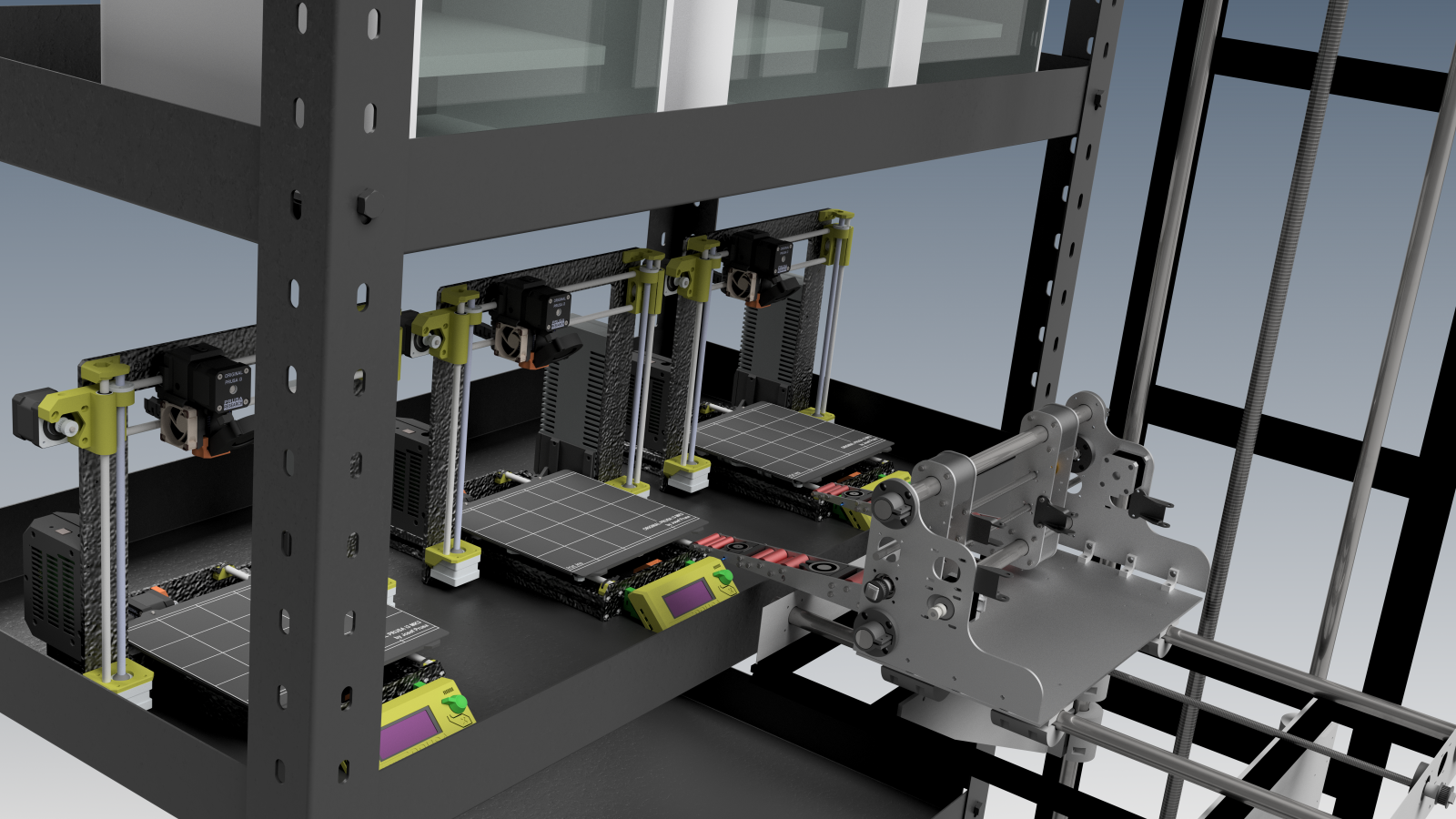
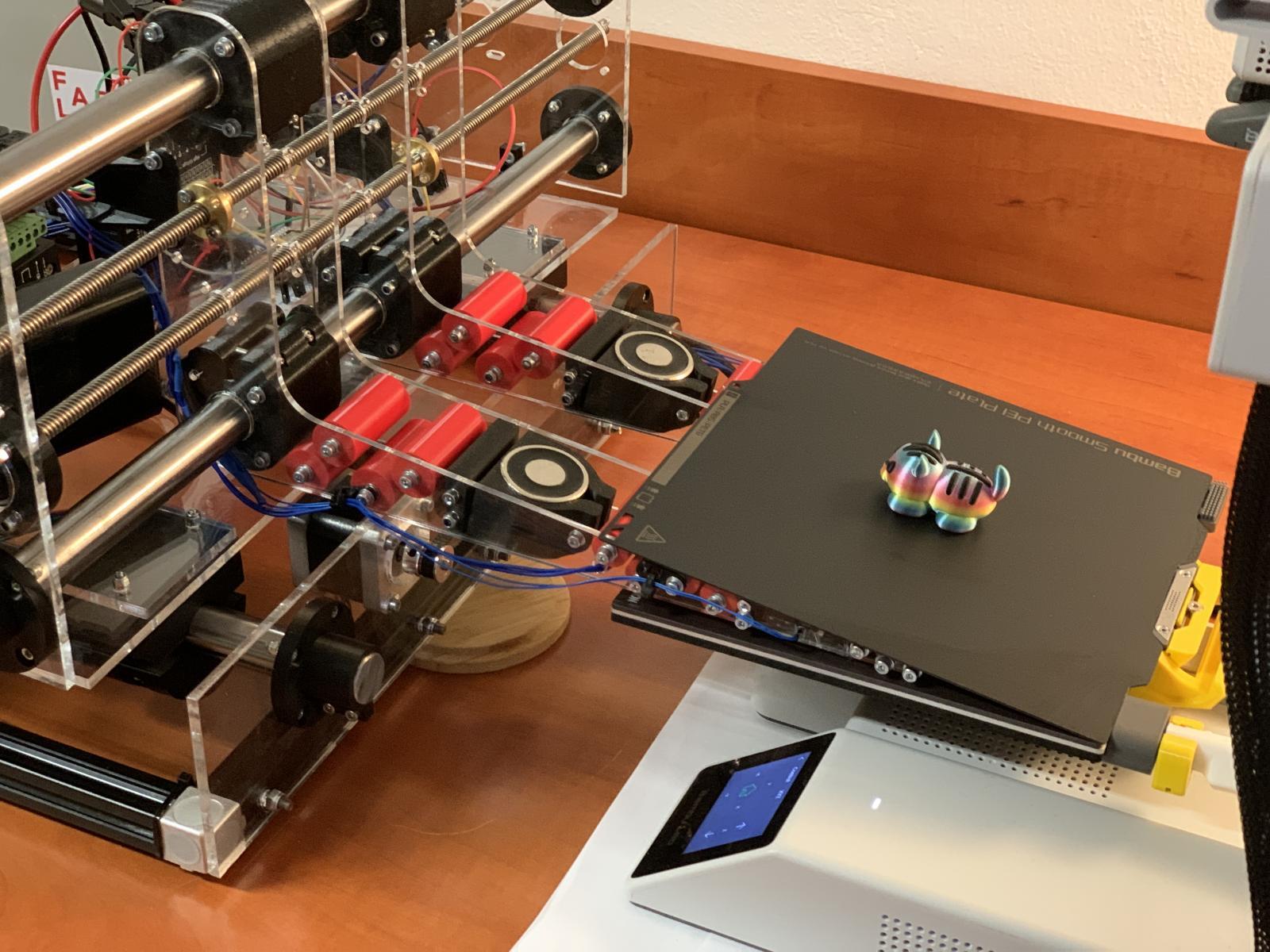
PrintrBot's solution allows 3D printers to handle tasks that would otherwise require employees. | Author: PrintrBot Archives Together with four fellow students, he decided to build a robot that would travel along a shelving unit and service several printers. “As soon as a printer finishes a job, it calls the robot. The robot removes the entire build plate with the printed object and replaces it with an empty one, allowing the printer to resume printing within a few minutes.It doesn’t have to wait for an operator who might only come round once an hour. Or it might be an engineer who regularly spends twenty minutes on the task when they could be doing more specialised and important work,” notes Miroslav Pejř.
The team first looked into whether similar solutions already existed elsewhere in the world and whether they could draw inspiration from them. They then broke the problem down into smaller parts. “If you try to tackle everything at once, it looks like an essentially unsolvable problem,” says Pavel Pejř, also from FME, who happens to be Miroslav’s cousin and is responsible for the electrical engineering and business aspects of PrintrBot.
Some team members therefore focused on the mechanical design, while others worked on the drives or software. “That enabled us to build a working prototype in just under six months,” adds Pavel Pejř.
To find out whether companies would actually be interested in their solution, they approached them directly. “We sent a questionnaire to around a hundred companies specialising in 3D printing or using 3D printers in some way. Most of the feedback we received was positive. We also got ideas and comments that helped us revise our original business plan. For example, the scope of what companies needed and what they wanted us to focus on changed,” explains Pavel Pejř. This also led them to drop some elements entirely after discovering there was no real market demand for them.
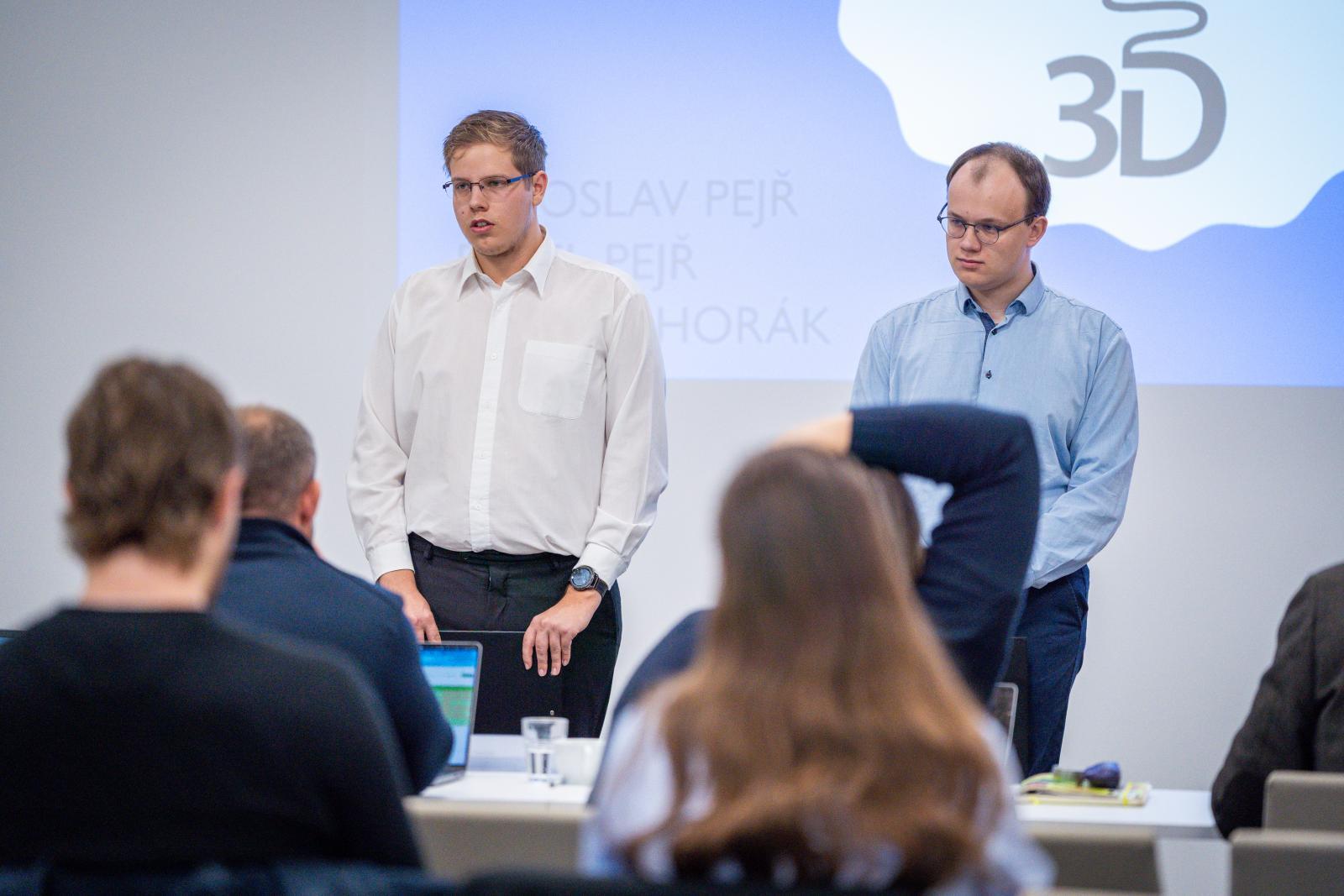
The PrintrBot team during their presentation in the second round of the BUT Student Entrepreneurship Award (now called “Go to Business!”). | Author: Václav Koníček In the future, PrintrBot would like to offer both custom development and its own integrated system that customers could purchase as a complete package. “Where companies already have shelving units, we have to tailor our solution to fit. But for those just considering investing in 3D printing, we would like to offer a complete solution equipped with our printers, workbenches and robots,” says Pavel Pejř.
They plan to start in Czechia, partly for practical reasons. “Initially, most of our work will probably involve custom solutions, so we want to focus on companies nearby that we can visit. But once we have the complete system ready, we would certainly like to expand internationally,” concludes Pavel Pejř with a smile.