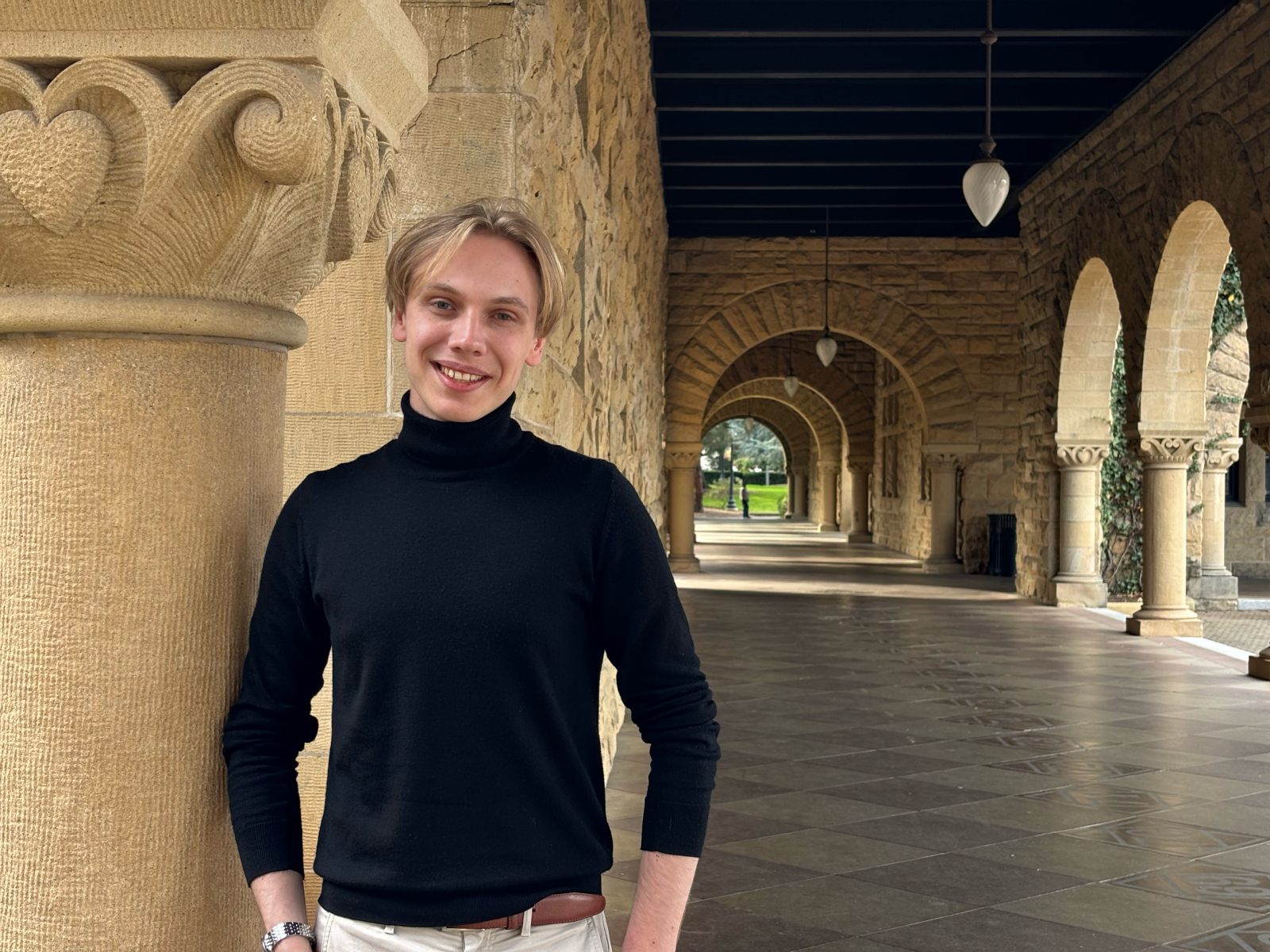
“In science, it often pays off to follow intuition and not be afraid of mistakes,” explains FME BUT graduate František Jeřábek. The talented pianist, who focuses on applied physics and semiconductors, has received the prestigious Josef Hlávka Award. He has also recently completed an internship at Stanford University in the United States, which he joined in his first year of doctoral studies at the Institute of Science and Technology Austria (ISTA).
You come from a musical family and played the piano intensively for years. Why did you decide to study physical engineering?
From an early age, I became familiar with the reality of the artistic world. It is a beautiful world, but in a musical career you often have to make compromises that I could not imagine for myself. During my high school studies, I visited the CEITEC Nano laboratories. That world felt distant and unexplored to me, and that was exactly what attracted me. I also attended open days at FME BUT. Many people said—whatever you do, don’t go into physical engineering, it’s the hardest. But when I experienced the atmosphere of the institute, I was captivated. It has always paid off for me not to be discouraged and to follow my intuition. And that was the case with physical engineering as well.
During your studies, you worked on several successful projects. What do you consider your most important experience?
That’s a difficult question. My first project focused on two-dimensional materials similar to graphene, and I started working on it at the end of my first year of bachelor’s studies—the opportunity to work in a lab was a kind of escape from the COVID lockdown. We focused on the synthesis of phosphorene and its characterization. Thanks to the unique equipment at CEITEC, we were able to study this sensitive semiconductor from multiple perspectives without exposure to air.
Gradually, partners from Virginia Tech joined the project, and the result was a publication in the journal ACS Nano. I also spent several years in an internship at Thermo Fisher Scientific, where I worked on the development of electron microscopy for life sciences, which allowed me to gain experience in an industrial environment.
Your master’s thesis also proposes a new method of data processing in semiconductor research. How did that come about?
Originally, we wanted to analyze defects in a gallium nitride-based semiconductor and obtain as much information about them as possible. To make that possible, I had to design a new way of processing data from structural analysis. Software engineering was a completely new field for me, but it turned out that this method would become the most valuable outcome of the entire thesis. It makes it possible to transform a conventional scanning electron microscope from a tool for qualitative analysis of crystallographic defects into a quantitative method operating on a much larger scale.
You haven’t abandoned music, though—you still perform and even founded an artistic agency.
I founded the UNITART agency, which helps young artists with concerts or releasing albums, during the pandemic. It’s a way for me to give something back to the environment I grew up in. I still perform at concerts or attend improvisational events several times a year, but I’ve had to scale back. However, I’m planning to release my first album of original compositions in the future.
Music remains an important counterbalance to science for me. Research requires a strong emphasis on logic and structure, while music is a very intuitive and creative process. Still, there is some overlap: in both classical music and science today, there is often a prevailing emphasis on perfection and polish. But if we look at history, we find that the greatest artists and scientists were always unconventional in their approaches. Perhaps that is why the music of great artists can still give us chills despite minor imperfections. Similarly, many scientific discoveries have arisen more by chance than through perfect planning.
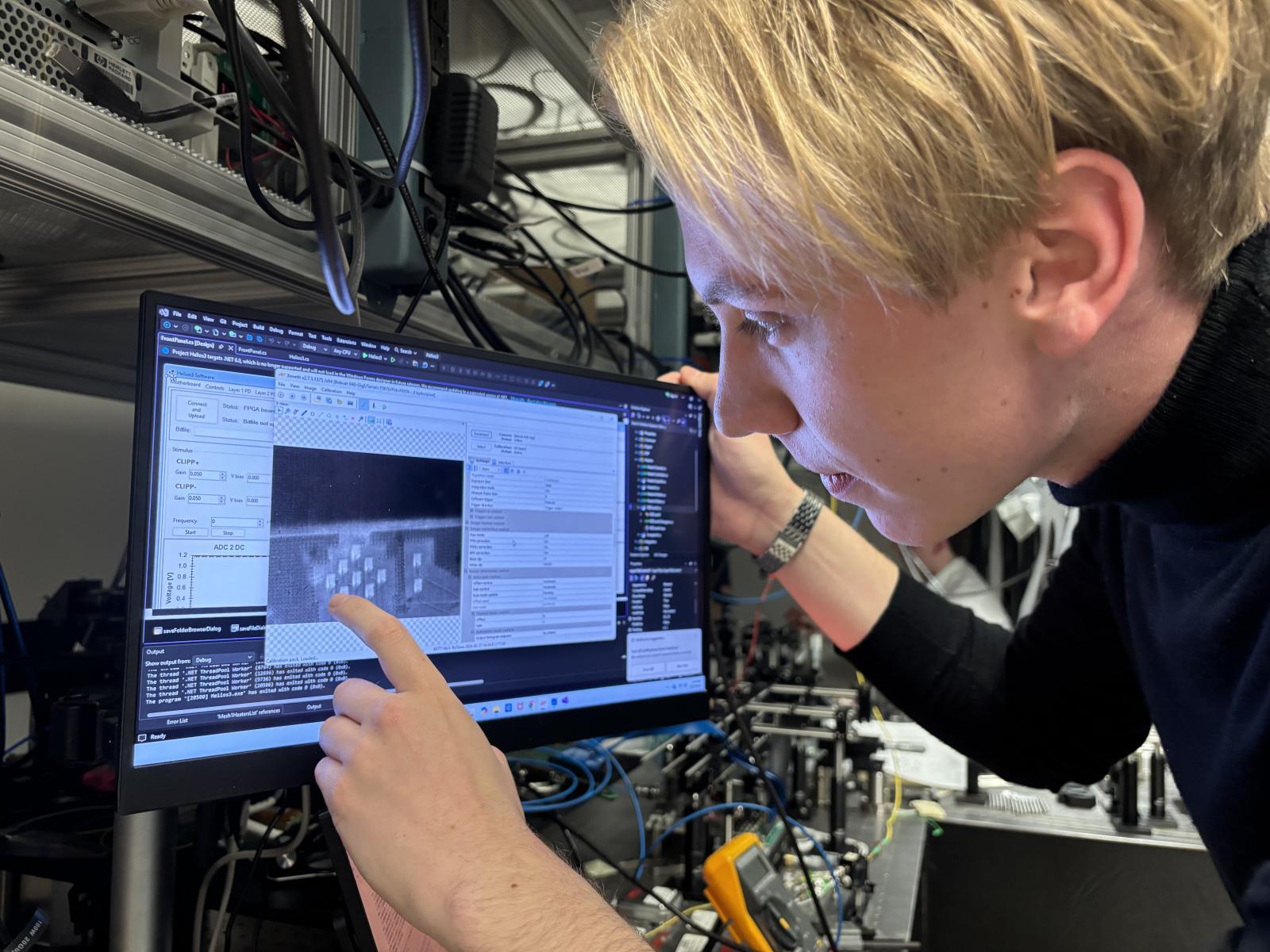
At Stanford, Jeřábek worked in one of the research groups there. | Author: Annie Kroo Do both fields also share an emphasis on detail?
Yes, one really has to be precise. However, I was greatly influenced by the president of École Polytechnique Fédérale de Lausanne, Anna Fontcuberta i Morral, under whose leadership I worked during my internship in Switzerland. Her laboratory is among the world’s leading research centers focused on semiconductors and their applications in photonics. Anna noticed that as a pianist I tend toward perfectionism and pointed out that excellence in science is not about perfection, but about curiosity.
A mistake that we use or learn from is an essential tool of top-level science and music, and fear of it must not stand in the way of pushing existing boundaries. I will be grateful all my life that my mentors guided and inspired me in this way—the pianist Karel Košárek, the physicist Miroslav Kolíbal, and last but not least, my mother.
After studying at BUT, you began a PhD at ISTA, where international competition is very strong. What was the admission process like?
Last year, around seven thousand people applied, and approximately eighty students across all fields were admitted. The admission process has two stages–in the first round, you need to secure recommendations, describe your previous projects, and explain your motivation to work with specific research groups at ISTA. You also need to prepare a summary of a scientific article and propose how you would contribute to similar research. If selected, you then go through four interviews with different professors.
The institute places strong emphasis on interdisciplinarity, and in the first year students rotate through multiple research groups before choosing their main direction. So far, I have completed two projects–the first was in the field of semiconductor quantum computers, and the second focused on photonic chips.
So why did you decide to go overseas?
This project was initiated by Charles Roques-Carmes, who is currently establishing a new Nanophotonics group at ISTA. At the moment, however, he still collaborates with the Ginzton Lab at Stanford University, so he invited me to California to work together in person. It was truly enriching to experience work in an American research group and to meet so many inspiring individuals.
Your pace of life must be demanding. How do you manage everything?
I don’t. In past years, I slept four and a half hours a day and tried to do everything at one hundred percent. That doesn’t work in the long run. Eventually, your body forces you to rest. It sounds like a cliché, but you can’t help it. When things are going well, it’s like a drug.
Today, I try to maintain clear limits–such as getting enough sleep or keeping weekends free. It may slow you down a bit, but it allows you to function sustainably. I’m an ambitious person, but my main goal is to live a happy life, and that’s impossible without health and relationships.
You received the prestigious Josef Hlávka Award in the autumn—how did that feel?
I only fully realize it in retrospect. Of course I was happy, but it’s only now, when someone congratulates me, that it really sinks in. I don’t want to seek too much external validation, but it does confirm for me that the time spent on these things has meaning from an external perspective as well. And I appreciate that.
Your interdisciplinary approach has clearly paid off–would you recommend it to others?
I’m naturally curious—it energizes me. That automatically leads me to want to explore as much as possible. But there are many people who focus on a single thing and excel at it. You have to figure out who you are and what your strengths are. For me, interdisciplinarity is essential; for someone else, it might be distracting.
What has worked best for me is being honest with myself. When something feels like the right direction, it usually turns out that my intuition was right. At the same time, it’s important not to be afraid of mistakes. In science–and in music–mistakes and failed experiments are not failures, but tools of creativity and pathways to improvement. If curiosity guides you, a detour from a straight path can lead you to places you would never otherwise reach.