People
26 February 2026
"I enjoy innovating established products. Potential lies in electronics and software," says Pavel Schiller from ASN Plus

At first glance, it might seem that Pavel Schiller was not much of an academic type. From a young age, he struggled with dyslexia and dysgraphia. “For these reasons, studying took a lot of energy and required more effort from me,” he notes. However, he did not shy away from the challenge and completed not one but two university degrees. In addition to the Faculty of Mechanical Engineering at BUT, he also broadened his education with business insight at the Faculty of Business and Management at BUT.
Today, Pavel Schiller is not only a successful graduate but also a successful entrepreneur. While still studying, he founded a company to develop an educational application for children. He brought the entire project to the prototype stage and subsequently sold it to a large Czech software company. However, he did not spend the money earned from the sale on a holiday or a new car. “I co-founded a company and invested the money into it. Originally, I thought we would focus on the Internet of Things. Partly because it was a big trend at the time. And also because I enjoy it when machines or tools make human work easier,” Schiller explains.
They bet on IoT. But there was no demand
The assumption that the Internet of Things (Internet of Things – IoT – editor’s note) would be the next “big thing” did not materialize. “It had already existed for years before people started talking about it so much. And where IoT had sufficient added value to make it worthwhile to manufacture, deploy, and operate, it was usually already in place. Otherwise, it was more of a buzzword,” Schiller notes. Since it was difficult at the time to make a living solely by focusing on the Internet of Things, ASN Plus shifted to what was actually in demand. “We started developing what the market wanted,” says Schiller.
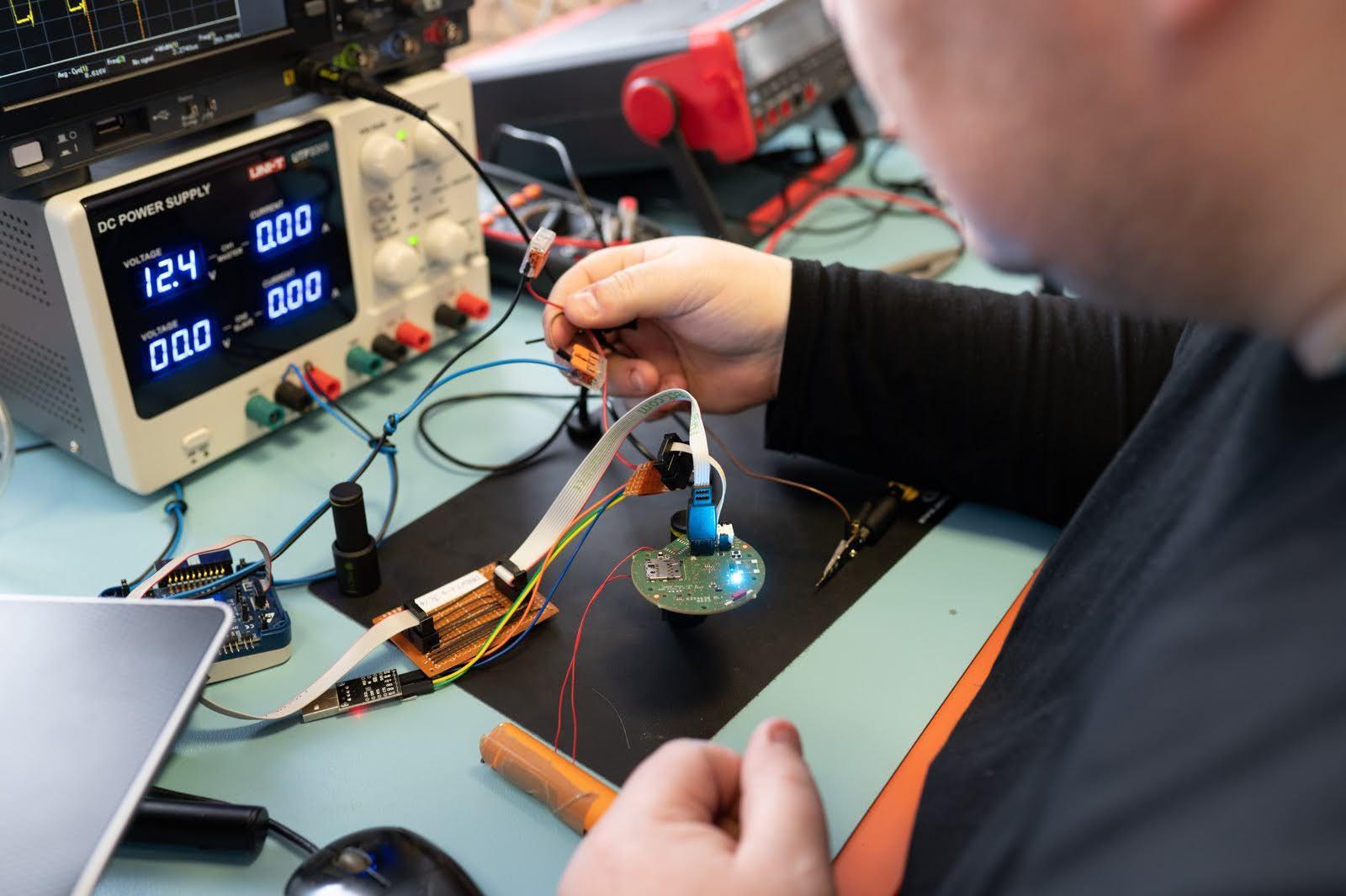
Today, the company primarily develops product ecosystems or their components according to customer needs. “We can deliver everything from the mechanical part through hardware, firmware, and software to the user application. We excel mainly in connecting the worlds of electronics, software, and business. Mechanics is more of a marginal matter that we address only when the customer has no other solution,” describes Pavel Schiller. For some customers, they completely replace the R&D department. Elsewhere, they supplement capacity, know-how, or experience.
External development teams like ASN Plus work on multiple projects simultaneously, which makes it possible to efficiently utilize development capacities during organizational and technological-management downtime and to gain more experience in a shorter time frame. “Much more often than internal development teams, we start something new from scratch, and this also contributes to faster learning and gaining experience, even though it is more demanding than sticking to what is known. This attracts developers who want to move forward and grow professionally. Thanks to this, we are able to choose technologies and solution architectures better so that they are efficient also for future production, development, and maintenance. At the same time, the experience gained by creating something new gives us a better position for innovating long-established products and systems,” adds Schiller.
An undeniable advantage of ASN Plus is Schiller’s education. In addition to technological development itself, he places great emphasis on the business aspect of every project. “For example, we also consult companies on marketing, which is not just advertising and sales. It is also about understanding the market and the customer. With customers from Western Europe, we see that this cross-disciplinary connection is stronger. Or at least there is greater respect between development and marketing than in the Czech Republic. This may be a legacy of the previous regime. At ASN Plus, we have built interdisciplinary experience and mutual respect. This allows us to collaborate much more efficiently and synergistically. Because you can develop technically interesting things, but if no one buys them at a realistic price, it is all pointless,” explains Pavel Schiller.
External development teams like ASN Plus work on multiple projects simultaneously, which makes it possible to efficiently utilize development capacities during organizational and technological-management downtime and to gain more experience in a shorter time frame. “Much more often than internal development teams, we start something new from scratch, and this also contributes to faster learning and gaining experience, even though it is more demanding than sticking to what is known. This attracts developers who want to move forward and grow professionally. Thanks to this, we are able to choose technologies and solution architectures better so that they are efficient also for future production, development, and maintenance. At the same time, the experience gained by creating something new gives us a better position for innovating long-established products and systems,” adds Schiller.
An undeniable advantage of ASN Plus is Schiller’s education. In addition to technological development itself, he places great emphasis on the business aspect of every project. “For example, we also consult companies on marketing, which is not just advertising and sales. It is also about understanding the market and the customer. With customers from Western Europe, we see that this cross-disciplinary connection is stronger. Or at least there is greater respect between development and marketing than in the Czech Republic. This may be a legacy of the previous regime. At ASN Plus, we have built interdisciplinary experience and mutual respect. This allows us to collaborate much more efficiently and synergistically. Because you can develop technically interesting things, but if no one buys them at a realistic price, it is all pointless,” explains Pavel Schiller.
Business potential and the right “chemistry” are essential
That is also why they carefully choose their collaborations. “We do not sell a commodity but a strategic partnership and cooperation. So it has to have business potential, but it also has to work on a human level. Without that, no collaboration brings the expected results—rather frustration. Setting expectations is also very important, because most people and companies, including our customers, operate outside research and development. If you apply expectations from design, manufacturing, purchasing, or sales to these processes, sooner or later you will have doubts and fears. And those are hard to overcome if you are collaborating with someone you do not feel comfortable with from the start,” says Pavel Schiller, adding: “Sometimes we meet a client who has a sufficient budget but insists on developing a device that, based on our experience and analyses, may not deliver the expected results. Or we simply do not click on a personal level. In such cases, we decline the inquiry. Our capacities are limited, so we carefully choose the projects we enter. We want to work on things that make sense to us.”

Although he now primarily focuses on managing the team, he still occasionally steps back into project work. “When something needs to be taken over because someone is on vacation and so on. As someone with a mechanical engineering background as well as a management education, I most enjoy projects involving a traditional product that companies no longer know how to innovate. Because you cannot make steel more ‘steel-like.’ That is where the space for innovation and competitive advantage lies—in software and electronics,” Schiller notes.
We are not afraid that AI will take our jobs, say ASN Plus
According to Pavel Schiller, he is not concerned that artificial intelligence will soon replace his company. “Mainly because we are a smaller company that can easily adapt to market changes. And thanks to AI, new opportunities are opening up for us. At the same time, we work with electronics, where AI still has limited added value—for example in creating schematics or physically debugging prototypes,” Schiller believes. At the same time, he admits that artificial intelligence does make their lives easier. “We use AI in professional development tools or, for example, in marketing. But we are not afraid that AI will take our jobs. Because we develop very complex systems communicating with electronics, often with multiple communication channels. That would be difficult to handle using vibe coding,” he points out.
This year, he plans to continue expanding the company to ensure sufficient capacity for interesting collaborations. “We are limited by our ability to recruit and train people. But we try not to overstretch ourselves and to leave room to select colleagues who are both great people and technologically skilled. To give you an idea, we might hire one out of eight applicants,” Schiller notes, adding that many BUT graduates have found employment at ASN Plus. “A large percentage of the people working here today started with us as interns or part-time students,” concludes Pavel Schiller.
(zeh)
Majáles returns after 2 years, royal candidates from BUT are ready to fight
The first woman at the head of the formula team has a great start
ARGO underwater: Prototype of student submarine on display at IDET Fair
Women from BUT who move the world of science and technology
BUT was a dream come true, says a graduate from Venezuela. Today she teaches Czechs about Latin American culture