People
25 May 2026
“An astronaut doesn’t have to be the best person in the room,” says cadet Tereza Bednářová

When Tereza Bednářová learned about the Zero-G project, she had only a few weeks left before her nineteenth birthday. “I told myself: you still can, so give it a try,” recalls the mechatronics student from the Faculty of Mechanical Engineering BUT. A few months later, she was among 26 Czech students who successfully passed a demanding six-round selection process and experienced weightlessness aboard a specially modified Airbus A310 during a parabolic flight.
The Czech Journey to Space project and the student Zero-G mission allowed selected young people to experience conditions normally encountered by astronauts in orbit. The flight took place on 30 March 2025 in cooperation with the French company Novespace, which also organizes similar missions for astronaut training and scientific experiments.
“Weightlessness is great for relieving your spine or taking a short rest. But the moment you actually want to do something, you quickly realize how used we are to gravity and how difficult it is to move in zero gravity. The ISS is full of handrails, and you can even find videos on YouTube showing astronauts getting stuck in the middle of a module and struggling to get out,” Tereza Bednářová describes her unique experience with a smile.
Parabolic flight works on the principle of free fall. During special manoeuvres, the aircraft creates conditions in which the crew experiences a state of near-complete weightlessness for several dozen seconds. For most participants, it is the closest experience they will ever have to actually being in space.Six rounds, stress and psychological testing

At the same time, she understands that the pressure was not pointless. “From the beginning, the plan was for us to become ambassadors of the Czech Journey to Space programme. That meant we needed to know how to communicate and handle pressure or negative reactions. I learned to trust myself more and to know that when things get tough, I can give my best,” she reflects. She now frequently uses these skills during lectures for young people and presentations at festivals, where she promotes space exploration.
“I enjoy spreading enthusiasm for space and showing people that it is no longer an unattainable dream,” she says. “I once read a quote: I was born too late to discover the oceans and too early to discover space. But I don’t think that’s true anymore. Today, we have a much greater chance of getting to space than ever before,” she adds, hoping that one day she herself will experience true weightlessness in orbit.
If we are to save ourselves, it has to happen here on Earth. I believe technology can help us enormously...
That is also why she decided to connect her future with technology. At the Faculty of Mechanical Engineering BUT, she studies mechatronics and is drawn to the development of space technologies, especially telescopes and satellite systems. “After grammar school, I wanted to do something more practical, to create things and work with my hands,” explains Bednářová, who met her training friend Ondra Wojtovič in the programme. She is particularly fascinated by the mechanisms of deployable structures in space. “What I love about satellites and telescopes is the origami aspect. You send a small package into space, and it unfolds into a huge structure. I find that amazing.”
She sees mechatronics as a field that could open the door to the European space industry. She is already looking into workshops and internships offered by the European Space Agency (ESA). Yet if you judged her only by her Earth-bound hobbies, you might be misled. She enjoys crocheting, growing houseplants and upcycling clothes. According to her, having diverse interests can actually be an advantage. “An astronaut is not necessarily the smartest or fastest person in the room. It is more someone who knows a little bit of everything and can adapt to different situations,” she believes.
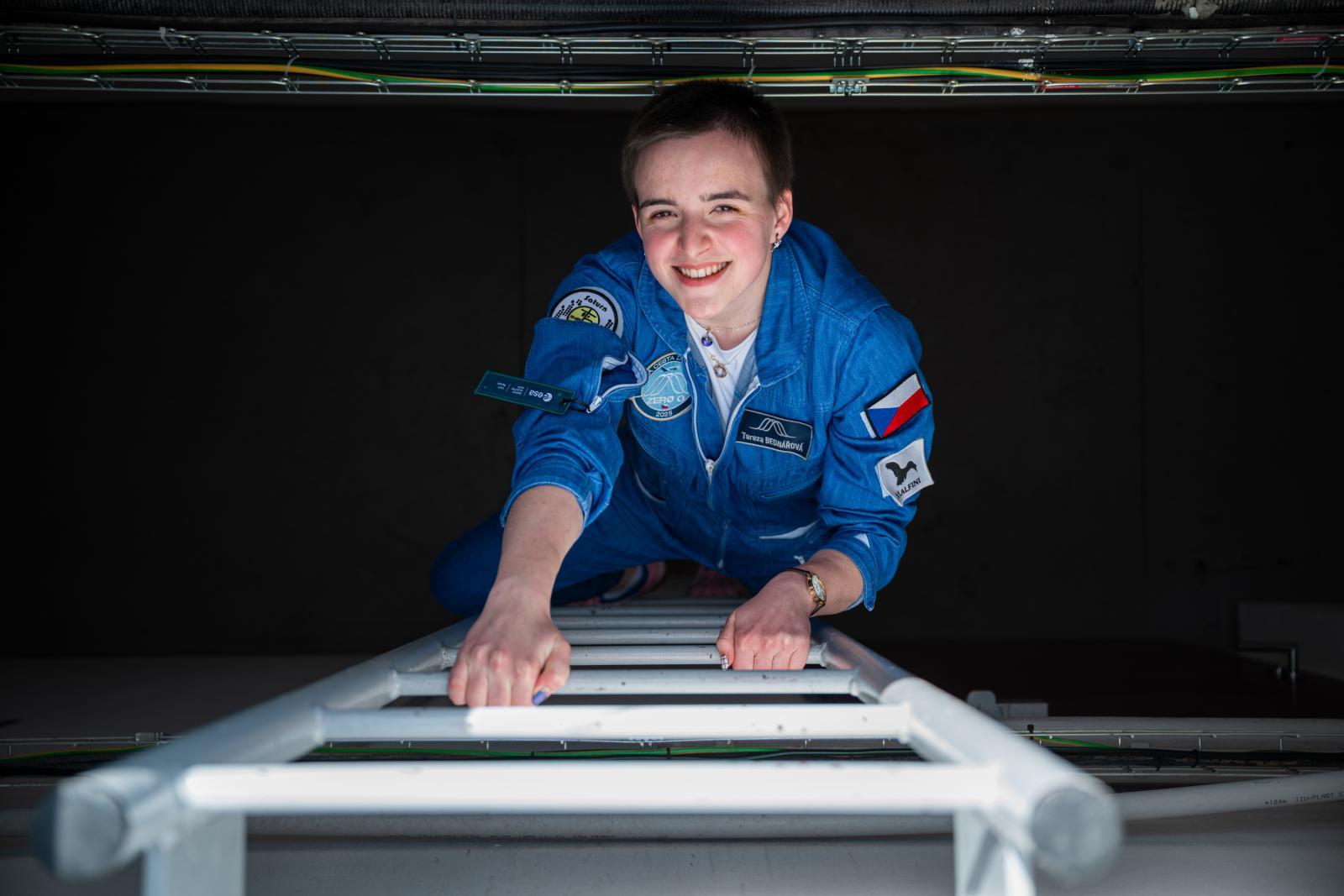
She is also deeply aware of environmental issues, and in her view, space exploration should not become an escape from Earth’s problems. “As they say, there is no Planet B. We are far too slow as humanity to escape in time. If we are to save ourselves, it has to happen here on Earth. I believe that not only space research, but technology in general, can help us enormously,” says Bednářová.
She considers the view of Earth as one shared home to be one of the most powerful ideas of modern astronautics. “The astronauts of the Artemis II mission recently talked about this as well: when you see Earth from space, you do not perceive national borders. You just see one planet where we all live. I think that this idea could one day bring us closer together,” she concludes.
(ivu)
Related: Mission Zero-G: Resistance in microgravity was verified by an experiment involving BUT - News – BUT
(ivu)
Related: Mission Zero-G: Resistance in microgravity was verified by an experiment involving BUT - News – BUT
Week at ESA? “I’d Go Back in Heartbeat,” Says Miroslav Palán
For water of even higher quality. Cavitation and low-temperature plasma technology purifies water from pesticides and hormones
Challenge as a lifestyle: strojLAB connects students and fields of study across BUT
Alexandra Streďanská’s fascination with fascia and hyaluronic acid
Software as a bachelor thesis helps with soil erosion research